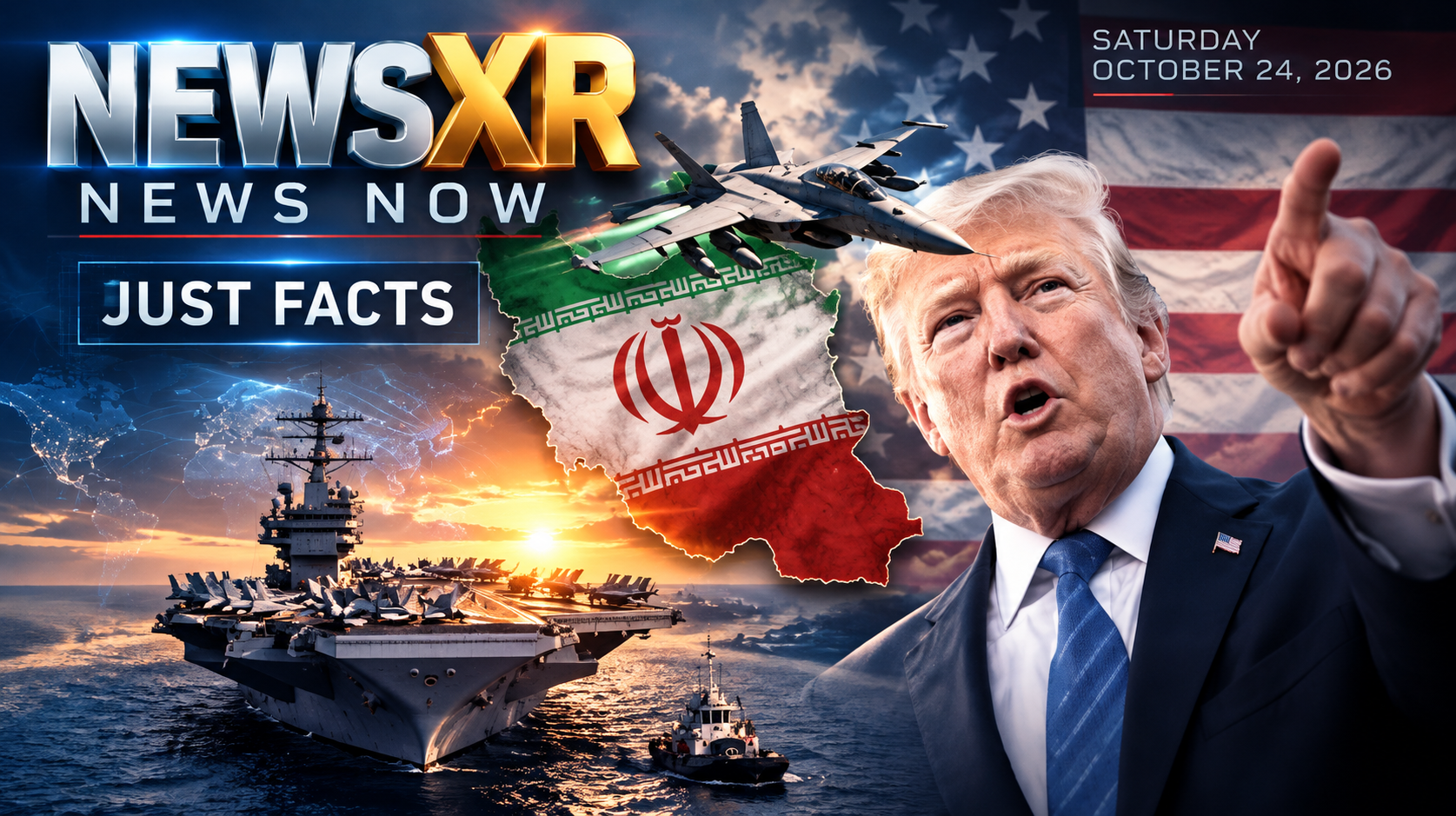
NewsXR News Now
Saturday, October 24, 2026
Good morning, America. From the overnight developments to the stories taking shape today, here’s what’s happening in our world.
This Saturday morning, the war involving Iran remains a major concern for the international community, with renewed diplomatic efforts competing against the possibility of further military confrontation. At home, an extraordinary federal lawsuit has raised questions about the certification of an approaching Senate election, while Americans prepare to vote amid rising energy prices. Across the Atlantic, France has mobilized tens of thousands of police officers to prevent another weekend of unrest, and in the American Southwest, dangerous flooding has forced families from their homes.
There is plenty to talk about over coffee this morning, including some remarkable work being done to find treatments for diseases that medicine has struggled to overcome. We’ll also revisit a devastating hurricane from exactly 100 years ago and finish with three young Americans whose simple idea is helping feed children thousands of miles away.
Let’s get caught up.
NOW: TOP STORY
Iran War: Tehran Calls for Renewed Negotiations as Threat of Wider Conflict Persists
The confrontation involving Iran, the United States and Israel remains one of the most consequential international developments facing the world this morning. Iranian President Masoud Pezeshkian said Saturday that Washington was responsible for the collapse of negotiations over an interim agreement, but he nevertheless called for another attempt to reach a deal. His remarks, broadcast on Iranian state television, suggest that at least part of Iran’s leadership still sees diplomacy as a possible way forward. Whether Washington and Tehran can agree on terms remains an open question.
The diplomatic uncertainty comes alongside serious concerns about how another round of military confrontation could affect international commerce and civilian infrastructure. Reuters reported Friday that two senior Iranian security officials described contingency plans for striking undersea communications cables in the Persian Gulf should American and Israeli attacks resume. Such infrastructure carries international data traffic, making the reported plans significant far beyond the immediate conflict zone. The existence of contingency planning does not establish that an attack has been ordered or carried out.
The economic consequences are already being felt in the United States. Rising fuel costs are becoming a significant issue in the congressional midterm elections, with diesel, gasoline and home-heating expenses adding pressure to household budgets and businesses. President Donald Trump has been defending his administration’s foreign policy while seeking ways to reduce the resulting economic burden. For Americans preparing for winter, the conflict is no longer simply a distant military and diplomatic concern.
Related News: Trump Turns His Attention Toward Cuba
President Trump introduced another potentially consequential foreign policy development during a campaign appearance in Florida on Friday. The president said his administration intends to address Cuba after the situation involving Iran is settled, placing the Caribbean nation squarely within his broader foreign policy agenda. Secretary of State Marco Rubio also called on Cubans seeking political change to cooperate with the CIA.
The statements come against a long history of confrontation between Washington and Havana. Cuba’s political future, American sanctions, migration and regional security have been recurring issues for successive administrations. Trump’s remarks indicate an interest in renewed pressure, but they do not establish that a military operation has been ordered or that a particular diplomatic agreement has been reached.
NOW: WORLD NEWS
France Deploys 70,000 Police as Nationwide Demonstrations Begin
France entered Saturday under an extraordinary security operation as authorities deployed approximately 70,000 police officers and gendarmes in preparation for nationwide demonstrations. The deployment represents an increase of roughly 10,000 officers over the previous weekend, when protests over living costs and deteriorating public services deteriorated into widespread vandalism and looting. In Paris, businesses boarded up storefronts, major cultural institutions closed, and more than 20 Metro stations were shut as a precaution. The government is attempting to preserve the right to demonstrate while preventing another outbreak of serious violence.
By early afternoon in France, Interior Minister Laurent Nuñez reported 135 arrests nationwide, including people detained following searches that uncovered items authorities believed could be used as weapons. The principal Paris march initially remained peaceful, while police used tear gas during confrontations in Lyon. The Louvre, Musée d’Orsay and Paris Opera were among the prominent institutions closed for the day. The unrest has become a major test of the French government’s ability to maintain public order amid growing frustration over economic conditions.
Ukraine and Russia Agree to Localized Ceasefire as Broader War Continues
Russia and Ukraine announced Friday that they had agreed to a localized ceasefire in Oleshky, a Russian-occupied Ukrainian town, while Ukrainian President Volodymyr Zelenskyy said negotiators would meet next month for renewed peace discussions. The arrangement was reportedly facilitated through U.S. First Lady Melania Trump. Although limited in scope, the agreement represents a diplomatic development in a war that continues to devastate communities and infrastructure. It does not amount to a nationwide ceasefire or a settlement of the broader conflict.
The announcement comes during a difficult period in relations between Kyiv and Washington. The Trump administration has criticized Ukrainian attacks against Russian energy infrastructure, while Ukraine continues to argue that strikes on facilities supporting Moscow’s war effort are necessary. Russian attacks on Ukrainian cities have continued, and both countries have reported additional strikes on industrial and military-related facilities. The prospect of another round of negotiations offers an opening, but conditions on the battlefield remain dangerous.
Starlink Restored as Questions Grow Over Private Control of Military Communications
Ukraine’s defense minister reported Saturday that SpaceX satellite communications had been restored following a period of restrictions affecting high-speed connections. Reuters separately reported that American administrations under both Joe Biden and Donald Trump have requested changes to Starlink services in Ukraine and the Middle East. Those requests illustrate the increasingly important role privately owned communications infrastructure plays in American foreign policy and international security.
Starlink has become especially important in Ukraine, where satellite connectivity supports military communications and other essential operations. The larger question now extends beyond one company or one battlefield: how much strategic influence should depend on infrastructure controlled by private corporations? Governments increasingly rely on commercial technologies, but their operational interests do not always align with those of the companies providing them.
Deadly Church Attack Shocks Jordan
Jordan is mourning victims of a deadly attack on a Greek Orthodox church in the Karak region, where gunmen opened fire during a funeral service Friday. Initial reports placed the death toll at seven, but subsequent reporting Saturday indicated that the number of people killed had risen. Approximately 40 people were reported wounded. The violence has deeply shaken a country where attacks of this nature are relatively uncommon.
King Abdullah ordered an aggressive security response as authorities continued searching for the attackers. Security precautions were increased around public gathering places, diplomatic facilities and other sensitive locations. Authorities described the shooting as terrorism, although the identities, affiliations and full motives of those responsible had not been established. The attack has brought renewed attention to the security of religious minorities and places of worship throughout the region.
Israel Displaces Palestinians During Hebron Operation
Israeli military operations in the occupied West Bank have displaced approximately 1,200 Palestinians from their homes in Hebron, according to reporting Saturday. The operation adds to the ongoing humanitarian pressure facing Palestinian communities amid the wider regional conflict. Families forced from their homes face immediate questions about shelter, personal safety and when they may be permitted to return.
The developments in Hebron come as tensions throughout the Middle East remain elevated. Military activity in the West Bank, the conflict involving Iran and the continuing consequences of earlier fighting have created overlapping humanitarian and security challenges. The immediate concern in Hebron is the welfare of displaced residents and the conditions under which they can safely return.
Brazil Faces a Closely Contested Presidential Runoff Sunday
Brazilian President Luiz Inácio Lula da Silva and Senator Flávio Bolsonaro are preparing for Sunday’s presidential runoff following a contentious final debate focused on living costs, public security and allegations of corruption. The candidates exchanged sharp criticism as each sought to convince voters that the other was responsible for the country’s economic and political difficulties. Bolsonaro, the son of former President Jair Bolsonaro, has positioned himself as an alternative to Lula’s administration. Lula is seeking another presidential term.
A CNT/MDA survey released Saturday placed Bolsonaro at 46.3 percent and Lula at 45 percent, a difference within the poll’s 2.2-percentage-point margin of error. The survey interviewed 2,032 people between October 21 and 23. The figures reflect voter preferences during the polling period, not the result of Sunday’s election. With the contest effectively tied, the final outcome remains uncertain.
NOW: NATIONAL NEWS
Federal Government Accuses Contractor of Leaking Classified Information to Newsletter Publisher
The Justice Department has accused a government contractor of disclosing classified national defense information to his girlfriend, who publishes a newsletter on Substack. The allegations, made public Friday, raise questions about the handling of sensitive government material and the relationship between classified information and independent publishing platforms. Prosecutors contend that information entrusted to the contractor was improperly shared.
The case involves criminal accusations, not an established finding of guilt. Authorities must prove the applicable charges in court, and the accused retains the presumption of innocence. The investigation also illustrates the complications created when information allegedly obtained through unauthorized government disclosures reaches a person engaged in publishing. The precise legal responsibilities of the individuals involved will depend on the evidence and the charges being pursued.
Kennedy Announces American Seafood Origin Labeling Initiative
Health and Human Services Secretary Robert F. Kennedy Jr. announced Friday that the federal government is moving to introduce clearer labeling for American-produced seafood. The initiative is intended to help consumers distinguish domestic seafood from imported products and make more informed purchasing decisions. Federal officials have described the effort as part of a broader strategy to support American fishing industries and strengthen domestic seafood production. The FDA has advanced draft guidance addressing voluntary U.S.-origin labeling.
For shoppers, the practical issue is knowing where seafood comes from before making a purchase. For commercial fishermen and domestic seafood businesses, clearer identification could help American products compete in a marketplace that relies heavily on imports. The initiative is a labeling and market-transparency measure, not a declaration that imported seafood is inherently unsafe. Its effectiveness will depend on how labeling standards are finalized and adopted.
Police Officials Resign Following Fatal Shooting of Mississippi Child
Two law enforcement officials in Mississippi have resigned following the fatal shooting of a 1-year-old child in a Walmart parking lot earlier this year. Reuters reported that the officer involved in the shooting and the city’s interim police chief stepped down, according to local officials. The child was killed in June, and the resignations represent a significant subsequent development in the case.
The death has raised serious questions about police use of force, public accountability and the circumstances surrounding the shooting. Resignation is an administrative development and does not itself establish criminal responsibility or resolve every question about the incident. The circumstances and any remaining legal proceedings require continued scrutiny. At the center of the case is the death of a child whose life cannot be restored by any administrative action.
NOW: COURT BEAT
Justice Department Files Extraordinary Alaska Election Certification Lawsuit
An unusual federal lawsuit filed ahead of the November 3 midterm elections is raising serious questions about the federal government’s involvement in state election administration. The Justice Department has asked a federal court to intervene in Alaska’s U.S. Senate election, potentially preventing certification of the results under certain circumstances. The administration argues that voters could be confused because two candidates on the ballot have nearly identical names.
Republican incumbent Senator Dan S. Sullivan faces Democrat Mary Peltola and another candidate, Dan J. Sullivan Jr. The Justice Department alleges that the similarly named challenger is attempting to divert votes from the incumbent. The challenger has denied that his candidacy is intended to confuse voters, and Alaska’s Supreme Court previously permitted him to appear on the ballot.
The federal lawsuit seeks an investigation into whether votes cast for the challenger were intended for the incumbent should the outcome be affected by the alleged confusion. Trump publicly endorsed the lawsuit Friday. Republican Senator Lisa Murkowski of Alaska criticized the action, while election law specialists questioned the federal government’s authority to interfere with certification on the proposed grounds. No court ruling granting the requested relief had been established in the reporting reviewed for this edition.
The case carries implications beyond Alaska. State governments administer federal elections under established legal frameworks, and disagreements over election procedures are generally resolved through the applicable judicial process. A federal effort to prevent certification before votes have even been counted introduces an extraordinary dispute over election administration. With control of the Senate potentially at stake, the proceedings warrant close attention.
Two Former FBI Officials Charged Over Congressional Testimony
Federal prosecutors have charged two former senior FBI officials with making false statements to Congress concerning their knowledge of investigations involving Hunter Biden, the son of former President Joe Biden. Court documents made public Friday describe allegations involving the officials’ testimony about earlier federal investigative activity. The charges place another politically sensitive matter before the federal courts.
A criminal charge is an accusation, not proof that the accused knowingly misled lawmakers. Prosecutors will need to establish the elements of the alleged offenses, including the required state of mind. The defendants retain the presumption of innocence unless and until guilt is established through the legal process.
NOW: WHITE HOUSE
Trump Signals Possible Changes for White House Press Corps
President Donald Trump said Saturday that he may move the White House press corps, introducing another potential change to the relationship between his administration and journalists covering the presidency. The proposal raises practical questions about where reporters would work and how any relocation might affect their access to officials and presidential activities. No completed relocation was established by the announcement.
The White House press corps plays a central role in providing the public with independent reporting on presidential decisions. Working arrangements, access to briefings and opportunities to question officials all affect the ability of journalists to obtain information. The significance of Trump’s proposal will depend on what specific changes are introduced and whether reporters retain meaningful access.
Administration Confronts Growing Energy Costs
As President Trump campaigns for Republicans ahead of the midterm elections, his administration is also confronting the economic consequences of its international policies. Higher diesel and heating oil prices are becoming increasingly important in states where energy costs can consume a substantial portion of household budgets. The administration has pursued measures aimed at easing fuel prices while maintaining its foreign policy objectives.
Those competing priorities present a difficult political problem. Policies intended to achieve international security goals can produce domestic economic consequences, particularly when they disrupt energy markets. For voters, the calculation is often much simpler than the underlying geopolitics: what does it cost to heat the house, fuel the car or operate a business?
NOW: CAPITOL
Congressional Control Hangs Over Final Days of Campaign
The November 3 midterm elections will determine control of the House of Representatives and Senate, making the final days of campaigning especially consequential for President Trump’s legislative agenda. Republicans currently hold narrow congressional majorities, while Democrats are seeking enough gains to regain control of one or both chambers. The outcome will determine how much support or opposition the administration faces in Congress during the remaining two years of Trump’s term.
The most competitive races are increasingly centered on household affordability, energy costs, immigration and the consequences of American foreign policy. Some voters are focused on the international conflicts dominating headlines, while others are weighing the immediate costs of groceries, transportation and housing. Those concerns frequently overlap, particularly when international developments affect domestic fuel prices.
SPECIAL FEATURE: MIDTERM COVERAGE
Kamala Harris Returns to Campaign Trail as Democrats Fight for Congress
Former Vice President Kamala Harris is returning to the national campaign trail as Democrats work to mobilize voters ahead of the November 3 elections. Her renewed political activity is drawing attention both because of her role in the party and because of questions surrounding the 2028 presidential race. Harris remains a prominent Democratic figure following her unsuccessful 2024 presidential campaign.
Her participation comes as Democrats attempt to bring together voters with differing positions on international affairs and domestic policy. In Michigan, for example, disagreements over Israel have complicated Democratic organizing, while concerns about rising living costs are providing common ground. The immediate objective is winning congressional races, even as attention turns toward the party’s longer-term leadership.
Trump Intensifies Republican Turnout Effort
President Trump is conducting a nationwide campaign blitz aimed at increasing Republican turnout and protecting the party’s congressional majorities. His appearances have emphasized immigration, foreign policy and the administration’s accomplishments while attacking Democratic candidates and their proposals. The rallies also reflect the president’s recognition that voter participation will be crucial in close races.
Republican candidates face the difficult task of defending the administration’s record while responding to concerns about higher fuel costs. Democrats, meanwhile, are seeking to make affordability and government accountability central election issues. The competing messages will receive their first decisive test when voters cast their ballots November 3.
Alaska Race Could Become a Major Election Night Flashpoint
The Alaska Senate contest is attracting national attention because of both its competitiveness and the Justice Department’s lawsuit. Republican incumbent Dan Sullivan is defending his seat against Democrat Mary Peltola in a race that could influence control of the Senate. The federal legal challenge adds another layer of uncertainty to an already closely watched election.
Election officials remain responsible for administering the contest under applicable law. Until ballots are counted and results certified, neither campaign can claim an official victory. The legal dispute and the actual election outcome are separate matters, and developments in either could have national consequences.
NOW: ECONOMY & BUSINESS
$8 Billion in Diesel Assistance for Farmers Scheduled After Election
The Trump administration’s plan to provide $8 billion in diesel assistance to American farmers will not begin delivering payments until after the November 3 midterm elections, according to an administration official. The assistance is intended to help agricultural producers cope with elevated fuel expenses that affect virtually every stage of farming. Diesel powers tractors, combines, irrigation equipment, freight transportation and other essential agricultural operations.
For farmers, higher fuel prices can quickly undermine profitability, especially when crop prices do not rise enough to offset operating costs. The administration’s assistance package may offer financial relief, but the timing means farmers expecting payments will have to wait until after Election Day. The broader economic pressure remains: sustained increases in agricultural production and transportation costs can eventually affect food prices paid by consumers.
Heating Oil Prices Become Election Issue as Winter Approaches
Rising heating oil prices are becoming a growing concern in the Northeast and other regions where households rely on oil-fired heating systems. The political consequences are particularly significant in competitive Senate races, where voters are evaluating how national policy decisions affect personal finances. Higher costs can be especially difficult for retirees, lower-income families and households living in older homes.
Unlike discretionary purchases, home heating becomes essential when temperatures fall. Families may be able to postpone some expenses, but they cannot simply stop heating their homes through a northern winter. The growing price pressure is therefore both an economic issue and a matter of household security.
BP and Louisiana Reach $350 Million Settlement
BP and the state of Louisiana have reached an agreement involving an accelerated $350 million payment connected to the 2010 Deepwater Horizon oil disaster. The agreement also resolves longstanding coastal damage litigation involving local parishes. The settlement represents another major step in addressing legal claims arising from one of the most consequential environmental disasters in American history.
The Deepwater Horizon explosion killed 11 workers and released enormous quantities of oil into the Gulf of Mexico, damaging marine ecosystems and coastal economies. More than 16 years later, the continuing legal consequences illustrate how long industrial disasters can affect communities and public resources. The new agreement addresses specific outstanding claims but does not erase the environmental history of the spill.
NOW: HEALTH & SCIENCE
Every Cure Uses Artificial Intelligence to Search for Overlooked Treatments
Some of the most promising advances in medicine may not come from inventing entirely new drugs. They may come from discovering what existing medications can do when used to treat diseases for which they were never originally developed. Philadelphia-based nonprofit Every Cure is pursuing that possibility through a combination of artificial intelligence, biomedical research and clinical partnerships.
The organization was co-founded by physician Dr. David Fajgenbaum, whose own medical history helped inspire its mission. While battling a life-threatening form of Castleman disease, Fajgenbaum and his research collaborators identified an existing immunosuppressant, sirolimus, as a potential treatment. The medication helped bring his disease into sustained remission, demonstrating how a drug developed for one purpose could become valuable against another condition.
Every Cure is now attempting to expand that approach systematically. Its MATRIX platform examines relationships among approved medications, biological pathways and thousands of diseases to identify treatment possibilities that researchers might otherwise overlook. Promising candidates must still undergo scientific evaluation and clinical testing, but the approach offers a potentially important way to accelerate research for conditions that attract limited commercial investment.
For patients with rare diseases, the work addresses a painful reality: available treatments are frequently limited, and developing entirely new drugs can take many years. Identifying a useful application for an existing medication may offer another research path. Every Cure’s work does not mean every disease already has a hidden cure, but it is expanding the search for treatments in a way that could make a meaningful difference to patients and families.
NOW: WEATHER & PUBLIC SAFETY
Severe Flooding Forces Evacuations and Rescues Across the Four Corners
Dangerous flooding across portions of Colorado, New Mexico, Arizona and Utah remains one of the most significant public safety stories in the United States this morning. Heavy rainfall over already saturated terrain has driven rivers above their banks, damaged roads and forced residents to evacuate. Emergency crews have conducted rescues involving people stranded by rising water, while officials have urged residents to avoid flooded roads and low-lying areas.
In northwestern New Mexico, approximately 600 households in the Farmington area were ordered to evacuate as the San Juan and Animas rivers rose. Emergency crews used boats, helicopters and specialized vehicles to reach stranded residents. Southern Colorado also experienced severe flooding, with conditions exceeding earlier forecasts in some locations. Colorado declared an emergency affecting 11 counties.
The National Weather Service continues to identify areas at risk of additional heavy rainfall and flash flooding, particularly in New Mexico and Colorado. Some of the higher mountain elevations may also receive significant snowfall as the weather system moves through the region. Conditions vary considerably across the Southwest, making local warnings especially important.
Residents in affected communities should follow official evacuation instructions and avoid traveling through floodwater. A roadway covered by moving water may conceal severe damage or be deep enough to sweep away a vehicle.
Typhoon Champi Leaves Hundreds Injured in Taiwan
Taiwan is assessing damage following the passage of Typhoon Champi, which killed at least one person and injured more than 500, according to reports Saturday. The storm brought damaging winds, uprooted trees and interrupted electrical service before weakening as it moved northward. Emergency crews have been working to restore services and address storm-related damage.
Although the typhoon was weakening, its effects continued to disrupt communities. The storm highlights the considerable risks associated with tropical systems, even when their strongest winds remain offshore.
Powerful Earthquake Strikes Near Vanuatu
A magnitude 7.2 earthquake struck waters west of Vanuatu early Saturday, according to the U.S. Geological Survey. The earthquake occurred approximately 200 kilometers west of Sola at a reported depth of 10 kilometers. Its strength and relatively shallow depth warranted attention from regional monitoring authorities.
Information about damage, casualties and any tsunami consequences requires confirmation from official emergency agencies. The South Pacific nation lies along an active tectonic boundary where powerful earthquakes occur regularly.
National Weather Outlook: Regional Contrasts Across America
Beyond the immediate flooding emergency, Saturday’s national weather picture varies considerably by region. Portions of the central and southern United States are experiencing comparatively warm conditions, while cooler autumn weather extends across parts of the Northeast and Mid-Atlantic. The strongest weather concerns remain associated with the western storm system and the potential for additional heavy precipitation.
The National Weather Service also expects unsettled conditions to extend into portions of the central and southern High Plains on Sunday. Higher elevations of the Rockies face snow potential, while parts of the eastern United States can expect seasonal temperature changes. Localized frost, rain and wind conditions will depend on individual regional forecasts.
THE DAY AHEAD
France’s Security Operation Continues
Authorities in France will be watching whether Saturday’s demonstrations remain largely peaceful or develop into another period of significant unrest. Arrest totals, injuries and any additional restrictions will become clearer as the demonstrations continue.
Brazil Prepares for Sunday’s Presidential Decision
Brazil enters the final day before its presidential runoff with no clear leader in the latest polling. Election officials will oversee Sunday’s vote as the country decides between President Lula and Senator Flávio Bolsonaro.
Southwest Communities Monitor Rivers and Additional Rainfall
Emergency officials across the Four Corners region will continue evaluating river conditions, road closures and evacuation requirements. Residents should expect conditions to change where additional rainfall falls on saturated ground.
Midterm Campaigns Enter Final Stretch
With Election Day approaching, both major American political parties are intensifying voter outreach. Developments in competitive Senate and House races, including Alaska, will remain important throughout the weekend.
NEWSXR THEN [Before XR]
October 24, 1926: A Caribbean Hurricane Leaves Communities Devastated
Exactly 100 years ago today, American newspaper readers were following reports of catastrophic destruction caused by a powerful hurricane that struck Cuba and the nearby Isle of Pines.
Contemporary coverage described devastated communities, damaged sugar and tobacco crops, destroyed buildings and a mounting human toll. Reports reaching the United States detailed the destruction of homes and public infrastructure as rescue crews struggled to reach isolated settlements.
Newspapers were also reporting extensive losses among fishing crews and vessels caught in the storm. Communications failures made it difficult to determine the full extent of the disaster, while medical personnel and emergency supplies were being sent to affected communities.
The October 24, 1926, edition of Washington’s Evening Star is preserved by the Library of Congress, offering a direct view of how Americans received news during an era when newspapers, telegraph lines and ships carried information across enormous distances.
The reports remind us how much disaster response has changed over a century. Modern satellites, emergency communications and sophisticated forecasting provide capabilities unavailable to people living in 1926. Yet the central human challenge remains familiar: protecting lives, reaching isolated communities and rebuilding after nature’s destructive force.
BUT HERE’S WHAT’S UP
Three Brothers, One Simple Idea, and Children Getting Meals Thousands of Miles Away
There are plenty of complicated problems in our world, but sometimes the people doing something meaningful about them are children who simply decide they want to help.
Three brothers connected to the Kids Can Inspire initiative have partnered with clothing brand SAVD on a collection designed to support children in Nicaragua. The campaign’s premise is straightforward: every shirt purchased provides a child with one month of meals. Rather than asking people to make a donation without receiving anything in return, the partnership connects an everyday purchase with an opportunity to help someone else.
The collection includes four shirt designs, each carrying a message connected to inspiration, faith, community or positive action. The campaign also brings attention to something easily overlooked in discussions about humanitarian assistance: meaningful contributions do not necessarily require extraordinary resources. A small initiative, supported by enough people, can grow into something that reaches well beyond the community where it began.
For the brothers, the project demonstrates that young people do not have to wait until adulthood to participate in making their world better. They can organize, collaborate with businesses, encourage others and help bring attention to people whose needs might otherwise go unnoticed.
There is also a broader lesson here about what happens when commercial activity and community service work together. A business sells a product, customers receive something they want, and a portion of that activity is directed toward helping children receive meals. The campaign presents a model in which commerce becomes a vehicle for generosity rather than an end in itself.
NewsXR previously featured this family’s initiative, and we are pleased to revisit the campaign as it continues reaching people who may want to participate.
For information about the Kids Can Inspire × SAVD collection, visit:
https://savdclothing.com/collections/kidscaninspire-x-savd
Three brothers, four shirt designs, and a mission to help feed children.
That’s what’s up, America.


© 2026 NewsXR. All Rights Reserved.


Leave a Reply