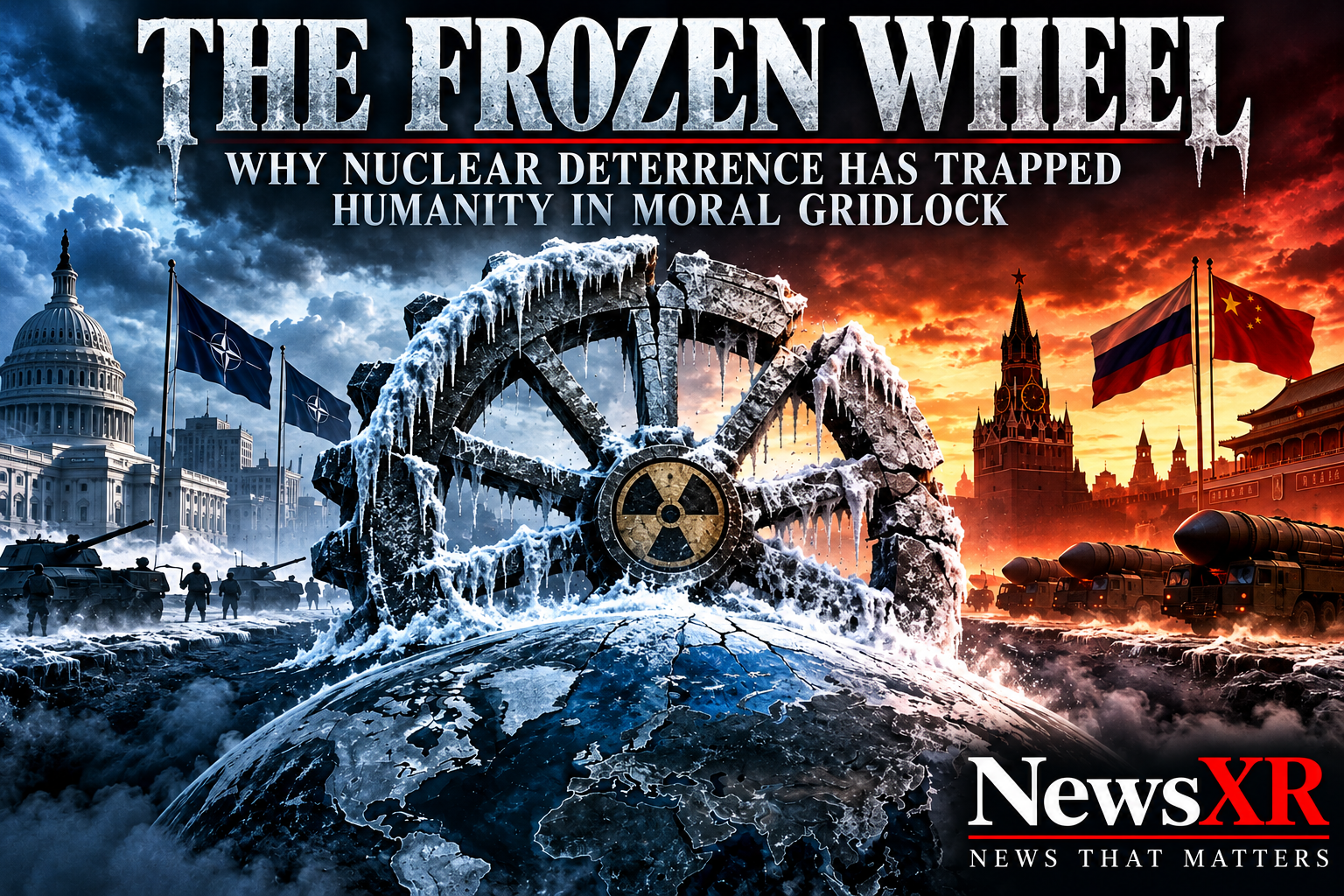
The Frozen Wheel: Why Nuclear Deterrence Has Trapped Humanity in Moral Gridlock
For centuries, human history moved to a brutal but predictable rhythm, defined by the cyclical buildup and destruction of global orders. Empires would rise, expand their resources, and eventually clash when their borders and spheres of influence overlapped. These historic friction points inevitably ignited a hegemonic war. This was a total conflict that, despite its horrific human cost, decisively shattered the old status quo, punished the vanquished, and cleared the ground for a new geopolitical architecture.
In 1945, that ancient wheel of history ran directly into an immovable wall.
The advent of nuclear weapons did not alter human nature, nor did it erase the friction between competing civilizations. Instead, it did something far more unnatural by artificially damming the river of history. By introducing the absolute certainty of Mutual Assured Destruction, atomic arsenals forced a permanent pause on the natural cycle of total war. For more than eighty years, this nuclear peace has successfully averted a direct battlefield clash between the world’s most powerful nations. But we are beginning to see the profound, tragic cost of this permanent freeze.
By keeping the natural buildup and destroy cycle at bay, nuclear weapons have made the resolution of global moral conflicts permanently unattainable.
In previous eras, a defining moral crisis like the global fight against fascism could be brought to an absolute conclusion. The oppressive regime was physically dismantled, its leaders were tried at Nuremberg, and the international order was forcefully rewritten toward a shared standard of justice. The victory was definitive because the material capability to enforce it existed.
Today, the nuclear shield has transformed sovereignty into an absolute sanctuary for structural evil. When a nuclear-armed superpower decides to redraw historical borders, absorb its neighbors, or systematically violate human rights, the international community finds itself completely paralyzed. Traditional international law becomes a toothless illusion. The West is left with an agonizing, impossible choice between attempting to forcefully resolve the moral conflict and triggering a thermonuclear third world war, or accepting a deeply fractured reality where powerful autocracies bully smaller nations with total impunity.
Faced with this gridlock, the modern world is fracturing along its natural, civilizational fault lines. Non-Western blocs, recognizing that the United States holds the keys to the global financial system, are actively building a parallel economic world order. They are hoarding gold, bypassing Western communication networks, and settling trades in local currencies. They are deliberately insulating themselves so they can operate freely within their regional domains without fear of Washington’s financial sanctions.
This brings us to the core truth that the modern rules-based international order refuses to acknowledge, which is that global stability may only be possible when we return to respecting the natural spheres of influence of superpower nations.
From the perspective of great-power realism, the current global tinderbox is not the result of regional aggression, but the consequence of the West violating the natural geography of power. Pushing military alliances and political influence directly into the historic backyards of other nuclear states, whether in Eastern Europe or the Taiwan Strait, creates an existential panic that forces those states to lash out. If the United States expects foreign rivals to honor the Monroe Doctrine and stay out of the Western Hemisphere, it must eventually concede that other superpowers will dominate their own neighborhoods based on shared history, language, and geography.
Honesty demands that we look directly at where this path leads if humanity fails to find a new way to resolve its differences. We must strip away the sanitized language of diplomatic strategy and face the unvarnished reality. In statistics and systems engineering, if a high-risk system runs indefinitely, the probability of a catastrophic failure eventually approaches absolute certainty. Nuclear deterrence relies on human leaders making perfectly rational, flawless decisions under extreme pressure forever.
If we continue down the current path, the system will eventually fail. A third world war will not look like the prolonged industrial mobilization of the 1940s. It will be an automated, hypersonic exchange of thermonuclear weapons. Within a matter of hours, major global cities will be obliterated, followed by an artificial winter that collapses global agriculture, effectively ending human history.
The only alternative to extinction is a fundamental, unprecedented evolution in how our species handles competition. If we cannot fight all-out wars to reset the global order, we must transition to new arenas to settle who leads. We are seeing the early stages of this shift as superpowers compete for dominance through artificial intelligence, quantum computing, space exploration, and alternative financial architectures. The winner of the global order will not be the nation that drops the most bombs, but the one that builds the most resilient, independent system.
We are trapped in a terrifying paradox. The very weapons that prevent humanity from destroying itself also prevent us from correcting global injustices. The tectonic pressure of our paused history continues to build behind a nuclear dam, while the world slowly splits into competing financial and political hemispheres. If we continue to ignore the natural order of regional spheres and fail to build a strictly managed alternative for technological and economic competition, we risk breaking the dam entirely, leaving no world left to save.
Leave a Reply