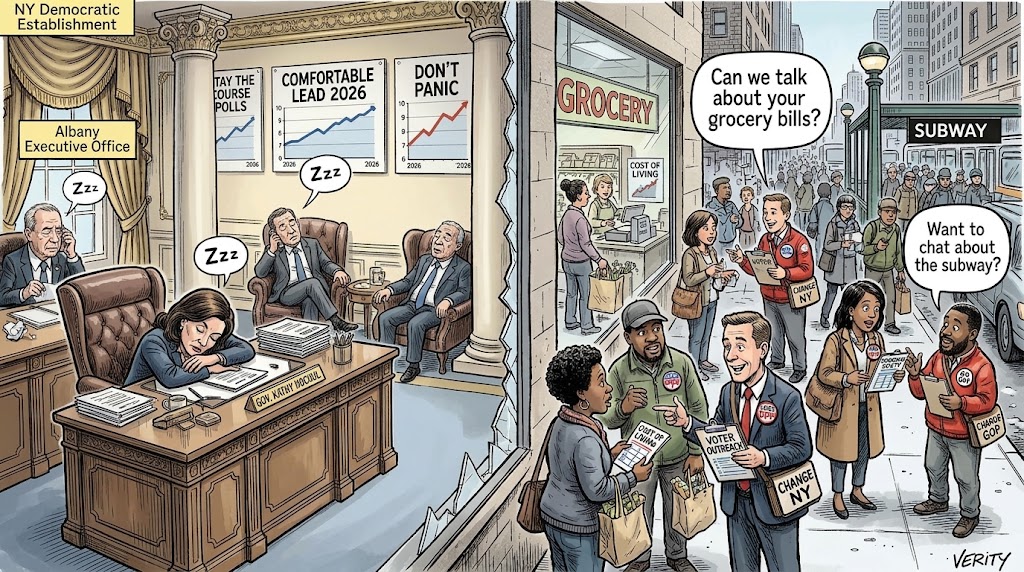
THE REPUBLICAN SURGE NEW YORK DEMOCRATS MAY NEVER HAVE SEEN COMING
An Election Day Editorial by R.D. Milano | NewsXR
I have a theory about tonight’s election, and if I’m right, the Democratic Party may be in for one of the biggest political surprises New York has witnessed in years. Let me make something clear from the beginning: I am not advocating for either political party, endorsing a candidate, or expressing a preference for who wins this election. I am making an observation and offering a prediction based on what I’ve personally witnessed and what I suspect may be happening behind the scenes. I could be completely wrong, and I readily acknowledge that possibility. But something has caught my attention, and I believe it deserves a closer look.
I suspect the national Republican Party may have quietly poured everything it could into capturing the New York governorship.
Not necessarily through the kind of noisy political campaigning everyone recognizes, but through something far more personal, deliberate, and difficult to measure. I suspect Republicans may have been preparing a political surprise that Democrats have not fully recognized. And if my theory is correct, the strategy could be as interesting as the election results themselves.
Now, I want you to think about something.
Have you recently found yourself listening to a political conversation at the grocery store, the gas station, or while standing in line at Walmart? Maybe two or three people were loudly discussing how Democrats have ruined New York, exchanging jokes about the state’s leadership, or talking about how badly New Yorkers are being taken for a ride. Perhaps someone approached you on the street, not to hand you a campaign flyer or ask for a donation, but simply to explain why they believe New York desperately needs a change. Did you dismiss it as just another political conversation?
What if some of those conversations weren’t entirely spontaneous?
I have personally encountered people approaching strangers to discuss what they believe Democrats have done to New York. No campaign brochures, no promotional materials, no banners. Just people who seemed remarkably interested in sharing their political opinions with anyone willing to listen. And I’ve watched small groups of older people at Walmart, buying minimal merchandise during busy shopping hours while loudly exchanging political jokes and criticisms that everyone nearby could hear.
Were those simply ordinary citizens exercising their freedom to speak? Very possibly. But I’ve begun wondering whether some encounters like these could represent something more deliberate. What if experienced political conversationalists have been strategically engaging the public in everyday places, creating discussions that appear entirely natural? What if the objective isn’t necessarily to persuade someone directly, but to plant a thought, reinforce an existing frustration, or encourage a conversation that continues long after everyone leaves the store?
Consider the potential effectiveness of such a strategy, if it exists.
A campaign advertisement announces itself as political persuasion. A flyer identifies the organization attempting to influence you. A campaign banner tells everyone exactly whose interests are being promoted. But a conversation between two strangers at the gas station carries none of those obvious identifying features. It sounds like ordinary people discussing the problems they face.
And that is precisely why I wonder whether Republicans have been conducting a grassroots effort that is far more extensive than the traditional campaign apparatus suggests.
My theory goes beyond New York Republicans organizing among themselves. I suspect Republicans from across the country may have quietly poured into New York to reinforce local efforts, recognizing the extraordinary national significance of capturing the governor’s mansion. I cannot prove that such an interstate operation exists or establish its scale. But I believe the possibility deserves consideration, particularly when I look at the intensity of the political conversations I’ve personally encountered.
And there may be a much larger political objective behind such an effort.
A Republican governor would possess the constitutional authority to pardon Donald Trump for his New York state criminal conviction. Imagine the political narrative Republicans could construct if New Yorkers elected a Republican governor who subsequently issued that pardon. The party could proclaim that even the citizens of the state that prosecuted Trump had rejected the Democratic political establishment. They could portray the election and pardon together as a vindication of Trump and a repudiation of what Republicans have characterized as the weaponization of government against him.
Whether that interpretation would accurately represent the motivations of New York voters is another matter entirely. An election result cannot tell us why every individual cast a ballot, and a pardon does not erase the underlying legal findings. But political narratives do not necessarily depend on such distinctions. My observation is simply that the opportunity to construct that narrative could provide national Republicans with an additional incentive to invest heavily in this particular governor’s race.
And that brings me back to the polls.
What if Democratic leaders have been looking at reassuring numbers while Republicans have been quietly concentrating on one objective: getting every possible supporter to the ballot box? What if the people conducting this effort understand that personal conversations can reach voters who ignore television advertisements and political mailers? And what if some of the political encounters New Yorkers have been experiencing in their everyday lives are part of a broader organizing strategy that has largely escaped public attention?
I am not claiming that every political conversation in a supermarket is staged, nor that the strangers I encountered were necessarily part of an organized campaign. I have no proof that a nationwide Republican operation has been deployed in the manner I suspect. I am offering my theory based on what I’ve observed, what I believe may be at stake politically, and the possibility that a major grassroots effort has been unfolding in plain sight.
And I want to emphasize something else.
My interest in this theory has nothing to do with wanting Republicans to win or Democrats to lose. It has everything to do with understanding how political campaigns operate, how voters are influenced, and whether the conventional methods of measuring public sentiment are capturing what is actually happening in our communities. As a journalist and observer, I find the possibility of a largely unrecognized grassroots operation fascinating, regardless of which political party might be conducting it.
I am making a prediction, not reporting an established fact.
The polls may be entirely correct. Democrats may retain the governorship, and my theory may prove to have little or no foundation. But I suspect there is a level of Republican organization, motivation, and national investment in this election that may have been substantially underestimated.
If New York experiences an unexpected Republican surge tonight, I believe the public should examine the organizing that preceded it. Not simply the television commercials, campaign rallies, or fundraising totals, but the everyday encounters that may have influenced people without ever looking like conventional campaign activity. And if the anticipated Democratic advantage holds, that result will be equally important in evaluating whether the political energy I’ve observed was representative of anything larger.
So before you dismiss my theory, think back over the past several weeks.
Did you hear that unusually loud political conversation at the market? Did someone at a gas station unexpectedly begin explaining how Democrats were ruining New York? Did you encounter strangers who seemed unusually eager to discuss politics without promoting a candidate, distributing a flyer, or asking for anything in return?
Maybe those were just conversations.
Or maybe, just maybe, something much bigger has been happening right in front of us.
I don’t know whether my prediction will prove correct. I am not asking anyone to accept it as fact or to vote differently because of it. I am simply sharing what I’ve observed, explaining what I suspect, and inviting readers to consider whether they have noticed anything similar.
Tonight, New York begins to deliver its answer.
What say you, America?
R.D. Milano
Publisher & Editor-in-Chief
NewsXR – Interactive News Network
© 2026 NewsXR. All Rights Reserved. Permission to Share Granted.
Leave a Reply