Category: Editorials
-

OPINION | NYS Prison Advocacy
OPINION | NYS Prison AdvocacyBy RD R.D. MilanoThe New York State Department of Corrections and Community Supervision is a failed and broken agency. It can no longer be trusted to carry out the mission the people of New York entrusted to it, or to keep anyone safe: incarcerated individuals, staff, or otherwise.The record is no longer deniable. New York’s own commissioned findings describe systemic failures, excessive force, retaliation, failed supervision, ineffective discipline, broken complaint systems, and leadership that allowed this culture to continue.What has been occurring inside New York’s prisons is a national disgrace. It is a human-rights catastrophe. It amounts to crimes against humanity, and it is occurring in one of the nation’s most liberal and progressive states.When we see a true Correctional Service acknowledging the people who could have been rehabilitated but perished instead, or who left prison worse than they arrived because of the system’s repeated failures, then we will see an agency capable of understanding people well enough to be trusted with helping change them.Until then what we see is an abomination. -

The Architecture of Arrogance: Why the Obsession with Universal Control is Breaking the World – and America
NewsXR Editorial – By R.D. Milano
The defining tragedy of the modern era is the exhausting, destructive delusion that peace can be engineered by forcing one group of people to live under the customs, beliefs, and dictates of another.
From the blood-soaked sands of our foreign interventions to the toxic trenches of America’s domestic cultural warfare, the human instinct to dominate has yielded the exact same predictable harvest:
-
Endless conflict
-
Staggering financial waste
-
A profound, irreparable fracture of society
It is time to accept a cold, fundamental truth that our political elites refuse to acknowledge: people do not want to be saved from who they are, and trying to force them into a single ideological box will never work. It breaks them, it breaks the system, and it is breaking us.
The Global Illusion of Control
On the world stage, this arrogance manifests as a relentless, multi-trillion-dollar global policing strategy.
For decades, the United States has operated as an ideological crusader, attempting to project its specific brand of governance onto ancient civilizations with entirely different histories, tribal loyalties, and cultural bedrocks. By continuously violating the natural boundaries of other superpowers’ spheres of influence – and pushing our military architecture right up to their doorsteps – we have not created global harmony.
Instead, we have bred deep, justifiable international resentment, bled our own treasury dry, depleted our weapon stockpiles, and left our homeland exposed.
A rational, mature foreign policy requires the U.S. to stop acting as the world’s self-appointed hall monitor. We must:
-
Retreat to our own geographic hemisphere
-
Secure our borders
-
Protect our trade routes
-
Leave other regional powers to govern theirs
A Double Standard in Washington
The ultimate hypocrisy is that when Washington operates abroad, it completely understands this logic.
When American diplomats, generals, and state-builders assist deeply divided nations – whether crafting frameworks in the Balkans or trying to stitch together a broken Iraq – they explicitly recognize that forcing distinct, deeply rooted cultures under a highly centralized authority is a direct recipe for civil war.
In those foreign theaters, the U.S. actively champions:
-
Localized autonomy
-
Regional devolution
-
Decentralized power-sharing agreements specifically structured so that one group cannot infringe upon or threaten the daily survival and values of another
Yet, the moment those politicians and bureaucrats fly back into Dulles Airport, this basic geopolitical wisdom is entirely abandoned.
Why can we not show the same basic respect to our own neighbors that we mandate for stranger nations across the globe?
America’s Cold Civil War
If objective foreign observers were to look at the United States today through the same analytical lens we routinely use to evaluate fractured societies abroad, their conclusion would be instant and glaringly obvious: the geographic and cultural factions within America are too vast, too deeply entrenched, and too fiercely opposed to ever be ruled by a single, centralized cultural decree from Washington.
An outsider looking at our political map would conclude that the only way to prevent a catastrophic collapse is to let each region and state rule itself, bound together not by a weaponized executive branch or a hyper-politicized judiciary, but by the decentralized, loose framework originally intended by our founders.
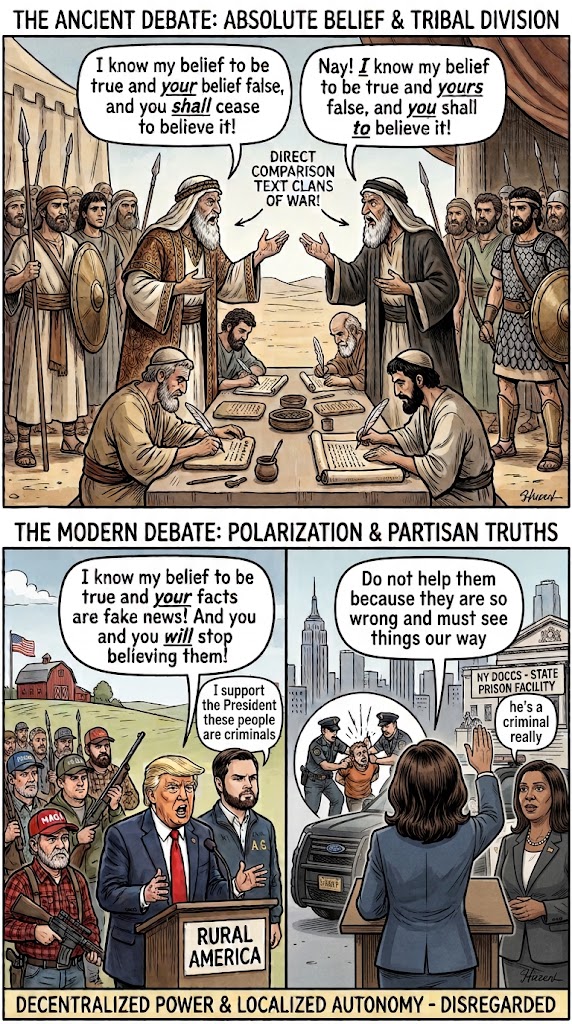
Instead, we are trapped in a de facto state of cold civil war, fractured almost precisely down the middle into two equally sized, equally powered tribal factions.
Consider what this actually looks like in our daily lives:
-
Look at a mother in a bustling New York City apartment, navigating a diverse, fast-paced urban landscape where personal autonomy and progressive social values are her highest civic ideals.
-
Look at a family in a rural Texas town, gathered under the lights of a Friday night football game, deeply rooted in faith, traditional community roles, and a conviction that life must be protected from the very moment it is ignited.
What is fundamentally, tragically wrong with modern America is that we have turned these two neighbors into mortal enemies by allowing them to vie for a centralized weapon of total control.
We have allowed the federal government to become an instrument of cultural conquest. The New Yorker feels an existential need to force her secular, progressive worldview onto the Texas town through federal mandates, while the Texan feels a moral duty to use federal law to dictate how the New Yorker must govern her own body.
Both sides spend billions of dollars, launch endless media blitzes, and weaponize executive orders in a desperate, never-ending cycle of building up and tearing down. It is an exhausting, toxic tug-of-war to bring the other half into submission – and it will never, ever happen.
The Cost of Forced Uniformity
We are constantly told by the political establishment that this total federalization of every moral, medical, and cultural issue is necessary to maintain a unified nation.
The reality is the exact opposite: this forced uniformity is what is destroying the Union.
We are fractionalized nationally because we are failing to respect our factions geographically at home, just as we fail to respect them abroad. This refusal to respect natural boundaries is the fundamental basis for every conflict we face.
We are not the same people. Our diverse geographic regions and distinct local cultures are what made this country a miraculous experiment, and trying to cram all of these unique regions into one suffocating federal box is suffocating the country to death.
Returning to the Founders’ Formula
The architects of the American republic foresaw this exact nightmare. To fix it, we are not calling for an end to the federal government; the exact opposite is true.
We envision a robust federalist union where individual states decide social and cultural matters according to the distinct will of their own people. The true purpose of the federal government in New York or Texas is to ensure that each state adheres to the Constitution’s guarantees of:
-
Equal treatment
-
Equal access to government
-
Basic order for its citizens
…not to tell New Yorkers what should be socially legal or tell Texans how to structure their local communities.
As originally designed, the formula was straightforward and elegant: a federal government restricted entirely to regulating interstate commerce, maintaining a unified defense framework, protecting constitutional baseline access, and preserving the union, while leaving the states to act as completely independent laboratories of democracy.
What Peace Looks Like
Imagine the sheer magnitude of what we could accomplish if we finally had the courage to return to this intended formula.
-
Picture an America where New Yorkers and Texans live in absolute, prosperous peace with one another because they have finally abandoned the exhausting, arrogant crusade to convert each other.
-
Imagine the astronomical wealth, the intellectual energy, and the human potential we could unleash if we stopped wasting our national treasure on a perpetual domestic war for federal dominance.
United by a common currency, a massive free-trade zone, and an unassailable continental defense, yet proudly and fiercely different in our local laws, we would instantly reclaim our status as the greatest, most resilient nation on earth.
And abroad, if we let the rest of the world live how they choose to live, withdrawing our military footprint to our own sphere of influence, the global resentment that poisons our foreign relations would evaporate. No one would hate us because we would finally be minding our own business.
Personally, I don’t align myself with either faction in America, because I’ve come to understand them as equally negative, destructive, dishonest, and tribalized. They are two sides of the exact same authoritarian coin.
But if we as a people are going to be tribalized anyway, we might as well do it by respecting our forefathers’ original intent.
Let New York decide for its own people if marijuana should be legal and if bodily autonomy should be absolute. Let the people of Texas decide if they want to recognize a life the exact minute it is ignited.
We must dismantle the federal machinery of control, stop using Washington as a weapon to conquer our fellow citizens, look inward to our own respective regions, and finally embrace the only durable formula for true peace: live, and let live or we’ll never live in peace.
-
-

Blood on the Tiers: Why New York Needs an Outside Disruptor to Smash the DOCCS Code of silence
Blood on the Tiers: Why New York Needs an Outside Disruptor to Smash the DOCCS Code of silence – By R.D. Milano
ALBANY, NY — New York State routinely brands itself as America’s progressive beacon of liberty, a sanctuary where human rights are codified and celebrated. There is a staggering, breath-taking irony in listening to Governor Kathy Hochul take to national airwaves to condemn Donald Trump and the Republican Party as uncaring, lawless, and a threat to a free society. While the Governor positions herself as a moral champion of democratic values, she presides directly over a national disgrace: a state correctional system operating as a violent abomination within our borders. Behind the secure perimeter of Building 2 on the Harriman State Office Campus, the administrative headquarters of the Department of Corrections and Community Supervision (DOCCS) oversees a system that completely betrays New York’s progressive rhetoric.
To be absolutely clear, this is not a partisan attack or an endorsement of alternative political ideologies; rather, it is a critique of the universal political tendency to weaponize national rhetoric while ignoring deep systemic rot at home. Consider the objective double standard: if a conservative governor presided over an agency where state employees murdered citizens and fabricated evidence to hide the crime, leaders across New York would rightfully decry it as an unconstitutional crisis. Yet, because this humanitarian failure is unfolding under a self-proclaimed progressive administration, the response from the Executive Chamber has been a masterclass in defensive stalling, proving that institutional self-protection transcends party lines.
The illusion of New York’s progressive exceptionalism was permanently shattered by the horrific, fatal beatings of incarcerated individuals Robert Brooks and 22-year-old Messiah Nantwi. The details exposed by independent investigators are not merely stomach-turning; they are the behavior of an authoritarian regime, not a free society. A Correctional Emergency Response Team viciously beat a young man nearly 70 times with batons and boots, deliberately turned off their mandated body-worn cameras, mopped up the blood, and planted a weapon in his cell to orchestrate a cover-up.
When a multi-million-dollar independent report by law firm WilmerHale pulled back the curtain on this rot, it revealed a toxic subculture driven by racial bias and a suffocating “code of silence.” Out of nearly 1,200 excessive force complaints filed in a single year, Building 2 substantiated fewer than 50. Not a single abusive officer targeted for termination by the state actually lost their job through the broken arbitration system.
Crucially, the failure of this leadership is not a one-sided tragedy. The current administration is not just failing incarcerated individuals; it is actively failing its own employees. By allowing a sick, toxic environment to fester—even after being handed explicit, irrefutable proof that it exists—the central office forces honest, well-meaning personnel to work inside a psychological pressure cooker. The WilmerHale report painted a grim picture of extreme staff burnout, crushing understaffing, and mandatory overtime. Good employees are left trapped in an institutional culture where doing the right thing means risking ostracization or severe retaliation, while bad actors are insulated from consequences. Management’s refusal to sanitize this workspace is a profound betrayal of the frontline staff who deserve a safe, professional, and ethical workplace.
The most disappointing element of this tragedy is the fierce, defensive resistance to change coming from DOCCS leadership itself. But should we really be surprised? Current Commissioner Daniel Martuscello III is the ultimate product of this very system. He is a multi-generational legacy insider who spent nearly 30 years climbing the ranks of the old guard, while his own brother historically ran the internal affairs unit tasked with investigating officer abuse. By keeping an entrenched insider at the helm, the Governor has signaled that protecting the political status quo matters more than protecting human lives or employee well-being.
It is a fundamental rule of institutional sociology that you cannot expect a leader to dismantle a toxic culture when that exact culture is what raised, protected, and promoted them. To an entrenched insider, systemic violence is rationalized away as an isolated incident, and external oversight is viewed as political interference. True reform will never emerge from the Albany bubble. A governor cannot legitimately lecture the nation on civil rights or human decency while allowing a national disgrace to ruin the lives of both the incarcerated and the staff in her own backyard.
If Governor Hochul wants to stop the hypocrisy and save the soul of New York’s justice system, she must bypass the compromised leadership class and deploy an extraordinary executive intervention: the immediate appointment of an independent Associate Commissioner for Special Assignment, recruited strictly from outside the agency.
Using emergency executive mandates to slice through civil service bureaucracy, this outside disruptor must be handed total operational authority to execute the two non-negotiable keys to cultural reform:
Seizing and Rewriting the Academy Curriculum: The DOCCS Training Academy must immediately abandon its outdated, adversarial paramilitary model. The outside reformer must bring in independent psychologists, criminologists, and de-escalation experts to rebuild the curriculum from scratch, ensuring that rookie recruits and veteran officers alike are trained in modern crisis intervention rather than a toxic “us versus them” mentality.
Directly Disciplining and Purging Facility Leadership: Culture is enforced by supervisors. The new Associate Commissioner must break up entrenched facility “fiefdoms” by using executive power to aggressively reassign, suspend, or terminate resistant prison Superintendents and wardens who tolerate abuse or protect the “blue wall” of silence.
New York cannot continue to preach progressive values to the nation while state employees murder young men, plant evidence, and work in unsafe, toxic environments with near-total impunity. True liberty requires accountability. It is time for the Governor to lock the old guard out of the room, empower an independent reformer, and fundamentally cleanse the culture of New York’s prisons from the top down. -

The Cycle of Control Is Breaking America
THE CYCLE OF CONTROL IS BREAKING AMERICA
A NewsXR Editotial
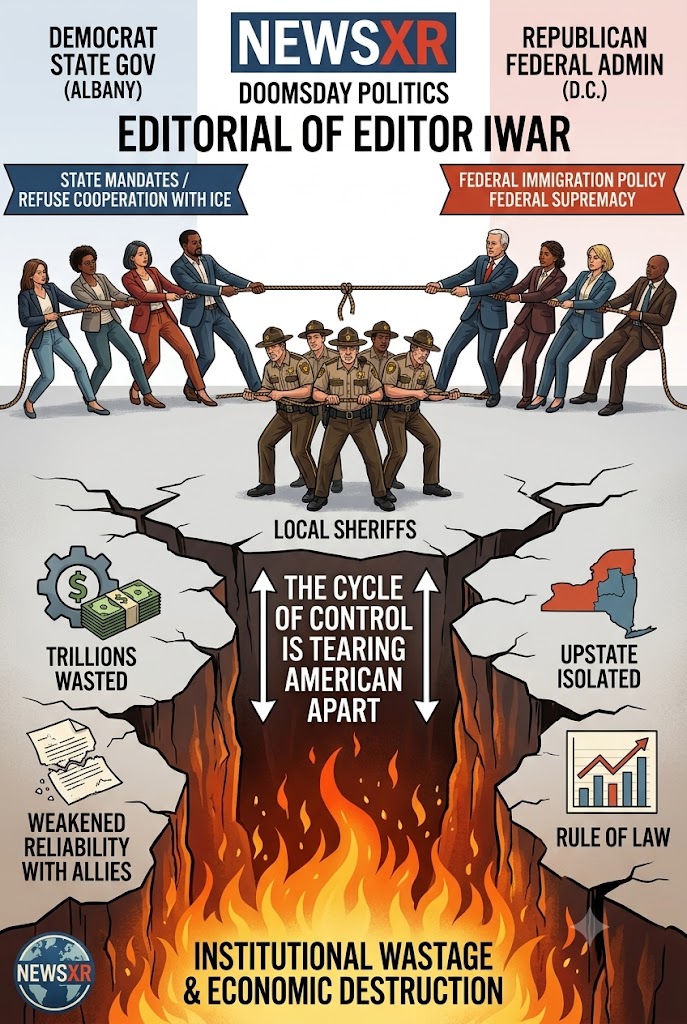
The underlying crisis in American politics is structural: the nation is divided nearly half and half, yet both major political parties operate under the delusion that they can force complete control over the other for four to eight years at a time. Rather than governing with humility, seeking consensus, or recognizing that half the country dissents, whichever party holds power treats a razor-thin victory as a mandate to impose its vision by force, silence opponents, and dismantle long-standing norms. The crazy part of modern governance is that if nearly half the nation feels completely differently than you do and you simply do not care, you are not leading; you are part of the problem.
It has always been, and should always be, a fundamental tenet of a healthy constitutional republic that you respect the will of the people and grant your political opponents the space to govern when they win the election. This modern brand of perpetual obstructionism under color of law is a gross abuse of institutional power and conduct unbecoming of public leadership. When officials use their posts to weaponize procedures, block legitimate oversight, and nullify lawful authority, they place partisan victory above the preservation of the constitutional order, directly threatening the stability of the Union itself.
Beyond the civic damage, this constant pendulum inflicts staggering economic waste and institutional destruction. Every time control of Washington or state capitals flips, the incoming administration spends billions of taxpayer dollars erecting new regulatory frameworks, greenlighting massive federal projects, and reshaping public agencies, only for the next administration to tear them down four years later. Businesses are forced to spend trillions adjusting to whiplash policy changes, rules are rewritten overnight, and long-term investments in energy, infrastructure, and domestic manufacturing are repeatedly abandoned midway through construction. We are paying a premium for a government that builds only to demolish, burning public wealth on partisan revenge.
On the world stage, this domestic volatility guts American credibility and weakens our reliability with international allies. Foreign partners and international treaties require consistency, but global democracies now watch Washington in disbelief as major trade agreements, environmental accords, and military alliances are signed under one president and unilaterally ripped up under the next. When American commitments expire every four years at the ballot box, our word becomes worthless, national security is compromised, and both foes and allies learn that long-term strategic partnerships with the United States are built on shifting sand.
This top-down warfare is not an abstract political debate; it is playing out right here in our own backyards across Upstate New York. In Albany, a Democratic state government uses legislative mandates to dictate how independently elected, predominantly Republican county sheriffs administer local public safety. Speaking on this mounting friction in a recent statement, Broome County Sheriff Fred Akshar pointed directly to state-level overreach, stating: “And frankly, I think every, I would, I would like to think that the vast majority of New Yorkers, uh, understand that the political class in Albany continues to destroy the great State of New York.”
While Sheriff Akshar’s remark highlights the frustration felt by local officials dealing with state mandates, NewsXR takes that indictment a step further: we believe the political class on both sides of the partisan spectrum is destroying this great nation.
When state leaders use preemption to strip locally elected sheriffs of their operational discretion, or when national party bosses demand uncritical obedience to partisan dogma, they are placing political power over public trust. When local officials are caught in the crossfire of conflicting legal orders, the public is left with a fragmented, untrusted system of justice where the law changes depending on which political seat you stand in.
When political leaders normalize resistance to the legal order at home, they compound this domestic instability regardless of which party is driving the vehicle. Donald Trump’s rhetoric leading up to the events of January 6 was wrong, reckless, and a direct threat to the peaceful transfer of power. Encouraging a crowd to challenge constitutional procedures damaged public trust in democratic institutions and crossed a line that no responsible public official should ever cross.
At the same time, current state and local governing bodies encouraging active resistance to federal immigration enforcement and ICE operations are engaging in equally reckless behavior. Passing state mandates that forbid local law enforcement from cooperating with federal law enforcement or honoring federal detainers places state authority in direct confrontation with federal supremacy and constitutional governance. When state officials order local law enforcement officers to ignore federal statutes, they undermine the rule of law in the exact same manner they claim to oppose.
NewsXR condemns both.
You cannot condemn political violence and constitutional overreach on the right while actively promoting state-sanctioned nullification and federal lawlessness on the left. The constant effort by one half of the country to rule over the other half as if they do not exist is tearing this republic apart, wasting trillions of dollars, and bankrupting our national credibility. Until the political class on both sides stops treating half the country like an enemy to be conquered, the American public will remain trapped in their destructive crossfire.
Have an opinion? Drop your comments below.

© 2026 CompanyXR Media Group. All Rights Reserved.
-

The $50 Million Question – How Broome County Keeps Renting a Solution to a Housing Problem It Needs to Own
Investigative Editorial: The $50 Million Question – How Broome County Keeps Renting a Solution to a Housing Problem It Needs to Own
Six people died in the Knights Inn fire in Endwell, a property that had become part of Broome County’s emergency housing system. The criminal case will address who allegedly caused the fire, but that investigation cannot answer the larger public-policy question exposed by the tragedy: Why has Broome County continued spending millions of taxpayer dollars placing homeless residents in privately owned motels instead of acquiring, renovating, or constructing housing the public could own?
This is not simply a question about one motel or one fatal fire. It is about an emergency housing strategy that has consumed extraordinary amounts of public money while producing no permanent housing inventory, no accumulated equity and little public control over the properties where vulnerable residents are placed. County officials have now acknowledged that the motel model is costly, unstable and inadequate as a long-term response to homelessness. Moving away from that system is necessary, but announcing a transition is not the same as completing one. Broome County continues renting a solution to a housing problem it needs to own.
The Cost of Buying One Night at a Time
Broome County’s spending on emergency motel placements has grown from hundreds of thousands of dollars annually to millions. Publicly reported figures indicate that the county spent approximately $358,000 in 2018, while spending reached roughly $9.5 million in 2025. Officials also reported that millions more had already been spent during 2026.
Those figures should force a full public accounting. Taxpayers deserve to know exactly how much has been spent during the past five, ten and fifteen years, which motel owners received the money, what nightly or monthly rates were paid, how long residents remained in temporary placements and whether the county negotiated rates based on the enormous volume of public business it was providing.
The title of this editorial raises a $50 million question because the cumulative cost may be far larger than any single annual figure suggests. The exact total must be established through county payment records, contracts and budget documents, but the broader financial failure is already visible. Broome County has spent year after year purchasing temporary access to rooms without gaining ownership of the buildings, the land or any permanent housing capacity.
Emergency motel placements can serve an immediate humanitarian purpose. A family facing homelessness needs shelter that night, not after a lengthy construction process. The problem begins when an emergency measure becomes the operating model and remains in place long enough to consume money that could have financed permanent infrastructure.
Even if Broome County had borrowed money to purchase apartment buildings, acquire former hotels, renovate vacant properties or construct new supportive housing, taxpayers would have been making payments toward assets that would eventually belong to the public. Financing would carry interest, and publicly owned housing would still require maintenance, insurance, staffing and management. Those costs, however, would be attached to real property that could serve the community for decades.
By contrast, motel payments buy only another night.
Once that night ends, the public owns nothing more than it owned the day before. There is no equity, no land, no housing inventory and no lasting increase in the county’s ability to shelter people. The next emergency requires another payment to another private owner, and the cycle begins again.
The Human Cost Behind the Financial Failure
The Knights Inn fire brought the vulnerabilities of this system into public view. People experiencing homelessness were not staying at the property as ordinary travelers choosing among accommodations. They were placed there because the county relied on privately owned motels as an extension of its emergency shelter system.
That arrangement creates a basic accountability problem. The county pays for the rooms and determines where vulnerable residents are placed, but it does not own the property and may not control its maintenance, staffing, security systems or daily operations. Motel owners receive public money, while the government remains dependent on those owners to maintain safe and habitable conditions.
If fire, building, electrical or property-maintenance deficiencies were documented at the Knights Inn or any other motel receiving emergency-housing payments, the public deserves to know when those deficiencies were discovered, whether they were corrected, who verified the corrections and whether taxpayer-funded placements continued before the work was completed. Any finding that owners knowingly accepted public money while failing to correct significant safety hazards would raise serious questions about their complicity in maintaining dangerous conditions.
The same scrutiny must apply to government decision-makers. County officials, inspectors and social-services personnel should be required to explain what standards properties must meet before receiving emergency placements, how often those properties are inspected, what happens when violations are found and whether the county has ever suspended payments or removed residents because of unsafe conditions.
Legal responsibility for the Knights Inn fire will be determined through the courts and formal investigations. The public-policy responsibility is broader. Broome County chose to build its emergency housing system around private motel rooms it did not own and could not fully control. The fire demonstrates why that choice must be examined as more than a budget issue.
What the Money Could Have Purchased
The most important comparison is not between motel spending and a cost-free alternative. There is no cost-free response to homelessness. The real comparison is between money spent repeatedly on temporary rooms and money invested in permanent housing capacity.
Tens of millions of dollars could have supported the purchase of existing apartment buildings, the acquisition and conversion of one or more hotels, the rehabilitation of vacant residential properties or the adaptive reuse of underused commercial buildings. The county could also have used public funds as capital for larger state and federal housing grants, allowing local dollars to leverage substantially greater investment.
A county-owned housing network could include emergency units for immediate placement, transitional apartments for people moving toward independence and permanent supportive housing for residents requiring continuing assistance. Services for mental health, addiction treatment, employment, veterans, disability support and housing navigation could be located on-site or coordinated through the same system.
Ownership would also give the county control over safety standards, occupancy rules, security, maintenance and long-term planning. It would allow Broome County to renovate properties according to public need rather than repeatedly searching for available private rooms during each new emergency.
The county might have needed mortgages or municipal bonds to make those acquisitions. That is not an argument against ownership. Governments routinely finance schools, roads, public buildings and infrastructure because the public benefits from the finished asset long after the debt is paid. Housing should be examined through the same practical lens.
Broome County could have been paying mortgages on housing. Instead, it has been paying nightly rates on rooms it will never own.
The Public Deserves the Full Ledger
County leaders have announced plans to reduce or end reliance on motels for emergency housing. That direction is overdue and should move forward quickly, but the proposed change cannot erase the financial and policy decisions that produced the present system.
Before another plan is promoted, the county should release a complete accounting of emergency motel spending. That accounting should identify annual totals, individual recipients, property names, rates, length of placements, inspection histories, documented violations and the amount paid to properties while violations remained unresolved.
The county should also calculate what could have been purchased with the same money. That analysis should include actual local property sales, available apartment complexes, former hotels, vacant buildings and estimated renovation or construction costs. Taxpayers should not be asked to accept vague assurances that ownership would have been too expensive without seeing a documented comparison between both models.
A credible plan must also establish measurable deadlines. Broome County should state how many motel placements remain, when it expects to end routine reliance on those placements, what properties it intends to purchase or develop and how many publicly controlled housing units will be created.
Without deadlines, ownership targets and a public financial analysis, “moving away” from motels risks becoming another phrase that delays structural change while the payments continue.
A Crisis the County Cannot Keep Renting
Homelessness cannot be solved by handing someone a motel key and repeating the transaction every night. Emergency shelter is necessary, but emergency shelter must lead somewhere. It must connect people to stable housing, treatment, income, services and a realistic path out of the system.
Broome County has spent millions sustaining temporary accommodations while its permanent housing capacity remained inadequate. The result is a system that benefits from neither the flexibility of a short-term emergency response nor the stability of a long-term housing investment. It is expensive, difficult to oversee and incapable of producing ownership for the taxpayers funding it.
The Knights Inn fire should become the point when Broome County stops treating motel spending as an unavoidable cost and begins treating it as evidence of a failed investment strategy. Six lives were lost in a building used to shelter people through the county’s emergency system. That tragedy requires more than prosecution, condolences and another policy announcement. It requires a full examination of the conditions, contracts and spending decisions that placed vulnerable residents there.
After years of multimillion-dollar payments, taxpayers are entitled to ask what they own. They should be able to point to apartments, buildings, land and housing capacity purchased with their money. Instead, the public has accumulated receipts for rooms that belonged to someone else.
The county does not need to rent its way through another decade of homelessness. It needs to own the solution, control the conditions and leave taxpayers with something more permanent than another motel bill.
-

New York’s Prison Report Describes a Human-Rights Crisis. Albany Is Still Treating It Like an Agency Problem.
NewsXR Analysis: New York’s Prison Report Describes a Human-Rights Crisis. Albany Is Still Treating It Like an Agency Problem.
By NewsXR Staff
New York did not need a $9 million-plus law firm report to learn that its prison system was in crisis. It needed the will to believe the warnings before two men were beaten to death, and it needed a governor prepared to confront the correction-officer power structure that has grown stronger while administration after administration has grown weaker.
The 277-page WilmerHale review of the New York State Department of Corrections and Community Supervision lays out a prison system marked by rising force, failed oversight, outdated training, weak discipline, poor medical documentation, broken grievance channels, contraband, staff fear, incarcerated-person fear, and an “us versus them” culture inside state custody. The report found that both incarcerated people and DOCCS staff feel unsafe, and that staffing shortages have created a cycle of reduced programming, worse conditions, more misbehavior, unsafe work, attrition, and still fewer staff.
That is the official language. The moral reality is sharper. This is not just “corrections reform.” This is a state-abuse crisis, and in NewsXR’s view, Governor Kathy Hochul is now presiding over one of the worst documented state-custody human-rights scandals in the nation’s modern history.
Robert Brooks was beaten to death at Marcy Correctional Facility in December 2024 while handcuffed. The report says body-worn camera footage showed officers beating Brooks in the infirmary while other officers and staff failed to intervene. It also says the footage showed that use-of-force reports filed afterward were false. Three months later, Messiah Nantwi was beaten to death at Mid-State Correctional Facility during an illegal correction officer strike. According to the report, the indictment alleged that officers and sergeants conspired to cover up the killing by mopping up blood, meeting at a local diner to coordinate stories, planting a weapon, and writing false reports.
The report does not make a legal finding of crimes against humanity. But the conduct described belongs in that moral conversation. People were held by the state, unable to leave, beaten by state agents, watched by other state employees, and then buried under false reports, weak records, failed medical safeguards, and alleged cover-ups. That is the kind of abuse Americans are taught to condemn when it happens in rogue nations. But this happened in New York, the Empire State, a liberal-run state that sells itself nationally as a model of rights, dignity, reform, accountability, and progressive government.
The abuses described are not abstract. They are prevalent, persistent, and not safely confined to the past. Lives have already been lost under Governor Hochul’s watch, and the report she ordered tells the state that the same machinery that allowed those deaths – weak accountability, siloed records, broken discipline, unsafe facilities, staff fear, incarcerated-person fear, and failed oversight – still requires years of sustained work, resources, legislative action, and bargaining-agreement changes to repair.
That makes Hochul’s response unacceptable. A governor who orders a report this severe does not get to receive it with lukewarm language and agency-management posture. She asked for the diagnosis. She got the diagnosis. The diagnosis is a human-rights emergency inside state custody.
How can this be? The answer is ugly: the warning signs were already there.
WilmerHale found that prior incidents at Marcy and Mid-State showed escalating violence, inadequate discipline, and leadership breakdowns before Brooks and Nantwi were killed. Some officers allegedly involved in the fatal cases had prior substantiated misconduct histories. Other incidents involved different officers, which undercuts the comforting “few bad apples” excuse. The report says those prior incidents should have triggered urgent intervention and showed cultural problems including staffing crisis, morale crisis, frequent force, weak accountability, and ineffective oversight.
Reported uses of force across DOCCS facilities more than tripled over the past decade, even while the incarcerated population declined. The report says reported uses of force rose from about 6,000 in 2016 to about 22,000 in 2025. In 2025, the Office of Special Investigations received 1,189 complaints coded as excessive or unnecessary force or staff-on-incarcerated assault. Only 47 were substantiated, including 40 specifically for excessive or unnecessary force. Mid-State had the highest number of OSI complaints for alleged staff assault or excessive or unnecessary force, while Marcy ranked tenth among 40 facilities.
That gap should have Albany on fire. Either incarcerated people are filing massive numbers of unsupported complaints, or the state’s oversight system is failing to identify, prove, document, or punish abuse. WilmerHale’s findings point toward structural failure: bad data, paper systems, siloed records, weak discipline, poor review, retaliation fears, and oversight that reacts too late.
The people inside knew. At Marcy, 57.2% of incarcerated survey respondents said they felt unsafe or not at all safe from violence by staff. At Mid-State, that number was 62.2%. More than half of Marcy respondents and nearly half of Mid-State respondents said they had personally been involved in a use-of-force incident at that facility. Among those respondents, 93.9% at Marcy and 89.5% at Mid-State said the force was unjustified. Staff were not safe either. The report found staff fear as part of the same collapse, and even the state’s own review recognizes that safety for staff and safety for incarcerated people are bound together, not competing interests.
And Governor Hochul’s response has not matched the scale of the disgrace.
Yes, Hochul ordered firings after Brooks was killed. Yes, her administration directed the outside review. Yes, DOCCS says it has completed more than a dozen recommended actions and has nearly 50 more underway. DOCCS’ July 3 release framed the moment as “progress on safety, culture, and accountability efforts,” saying the reviews were conducted at Hochul’s direction and that the department had completed more than a dozen recommended actions before the reports were finished.
But that is exactly the problem. A state response to two prison killings and a report this severe should not read like a performance update. It should read like a government realizing that something monstrous happened under its custody, under its seal, under its command structure, and under its constitutional duty to protect people it had total power over.
Instead, the approach feels half-hearted. Hochul signed prison oversight legislation after the killings, but the final version was narrower than lawmakers originally sought. The Times Union reported that lawmakers had sought six new members for the State Commission of Correction, including people from various backgrounds, but Hochul opposed that broader expansion; the final deal added two part-time members, with one required to be formerly incarcerated.
That matters. A formerly incarcerated voice on the Commission of Correction should have been a historic power shift. Instead, the lived-experience seat was placed into a part-time structure. That is not full empowerment. That is symbolic inclusion with clipped authority.
The contradiction is obvious: New York wants the headline of lived-experience oversight without giving that lived experience the full institutional muscle it deserves. Even after those reforms, advocates still had to pressure Hochul to fully staff the Commission of Correction. Spectrum News reported in May 2026 that prison reform advocates said Hochul was not “holding up her end of the bargain” on appointing commissioners to fully staff the state jail and prison watchdog agency.
That is how confidence gets lost. Not in one speech. Not in one appointment. In the gap between promise and power.
Hochul now appears to have lost confidence across the board: among incarcerated people and families, among prison advocacy groups, and among employees and staff being left to work inside a broken system. Advocacy groups are demanding stronger oversight. Staff are saying their warnings were ignored. Incarcerated people are saying they are unsafe. Families are burying the dead. That is not a communications problem. That is a failure in state leadership, initiative, and moral responsibility.
No serious conversation about DOCCS can avoid the correction-officer block and the union power that protects it. WilmerHale states that NYSCOPBA represents correction officers and has historically been the most vocal union on safety, staffing, and labor conditions. The polite report language masks a political reality Albany has ducked for years: the correction-officer block has become one of the strongest forces inside the prison system. Governors change. Commissioners change. Slogans change. Press releases change. But inside the facilities, the correction-officer culture keeps its grip.
WilmerHale shows how that grip affects accountability. The report says DOCCS’ current discipline methods are insufficient to meaningfully deter misconduct, and that changes may require legislation or changes to union agreements. It says plainly that, under the union agreements, “DOCCS’ hands are tied,” and that NYSCOPBA and Council 82 contracts were up for renegotiation in 2026.
That is the opening. That is where real leadership either shows up or folds.
Hochul had a moment to break the correction-officer block. Not by declaring every correction officer an abuser, because the report itself notes many staff are dedicated and deeply dismayed by the killings. The professional officers should want the same thing the public should want: a system where violent, dishonest, retaliatory, camera-dodging, report-falsifying staff are removed fast and permanently.
But the illegal strike should have been the line. That was the moment for New York to say: we are rebuilding this system from the foundation up. We are firing every saboteur. We are removing every staff member who abandoned lawful duty, obstructed accountability, hid violence, falsified reports, ignored orders, or treated state custody like a private ganghouse. We are starting fresh with partners in public safety, not saboteurs of reform.
Instead, Albany blinked. The state fired some people. It deployed the National Guard. It spent money. It commissioned studies. It announced reforms. But it did not break the culture. It did not crush the correction-officer veto over accountability. It did not seize the moment to rebuild DOCCS around a new class of corrections professionals who understand that safety means safety for everyone behind the wall.
That failure sits with the governor. In NewsXR’s view, Hochul has lost the stomach to solve the crisis. She is managing it, messaging it, funding pieces of it, appointing around it, and talking through it. But she is not solving it.
Solving it means breaking the political and contractual machinery that lets brutality survive discipline. It means treating cover-ups as institutional attacks on the state itself. It means removing staff who sabotage reform. It means building a corrections workforce that sees incarcerated people as human beings in state custody, not enemies in a war. It means giving oversight bodies real power, not symbolic seats. It means treating advocacy groups as public-interest watchdogs, not post-crisis props. It means listening to staff before they reach collapse, not after the system is already bleeding.
Because when a man is beaten to death in restraints and official reports are false, that is not a training gap. When another man is beaten to death and officers are accused of planting a weapon, mopping blood, coordinating stories, and filing false reports, that is not a culture issue. When prior warning signs existed and the system still failed to stop the next death, that is not a communications problem.
It is an abomination. It is a national disgrace. And it happened in New York.
The WilmerHale report gives Albany a blueprint. But the state needs more than implementation. It needs recognition that custody is not a license for brutality, that “correctional culture” became cover for violence, that the union-backed correction-officer block cannot be allowed to function as a veto over accountability, that staff safety and incarcerated-person safety are not competing goals, and that paper reforms cannot substitute for power.
The warning signs were there. The grievances were there. The injuries were there. The prior incidents were there. The staff fear was there. The prisoner fear was there. The camera failures were there. The medical documentation failures were there. The union barriers were there. The use-of-force explosion was there.
Now Governor Hochul owns the next chapter. Not the report. Not the press release. Not the symbolic appointment. The result.
If New York can spend more than $9 million to study a prison-abuse crisis, appoint the first formerly incarcerated person to a limited part-time oversight structure, narrow the reform package, leave union power largely intact, and then answer prevalent and persistent human-rights abuse with lukewarm agency language, the public should ask the only question left:
How many warnings does the Empire State need before it finally acts like human beings are being held behind those walls?