NewsXR News Tonight
Saturday, October 24, 2026
Good evening, America. Here’s where things stand in our world tonight.
It’s been another consequential Saturday, and several of the stories we brought you this morning have taken significant turns.
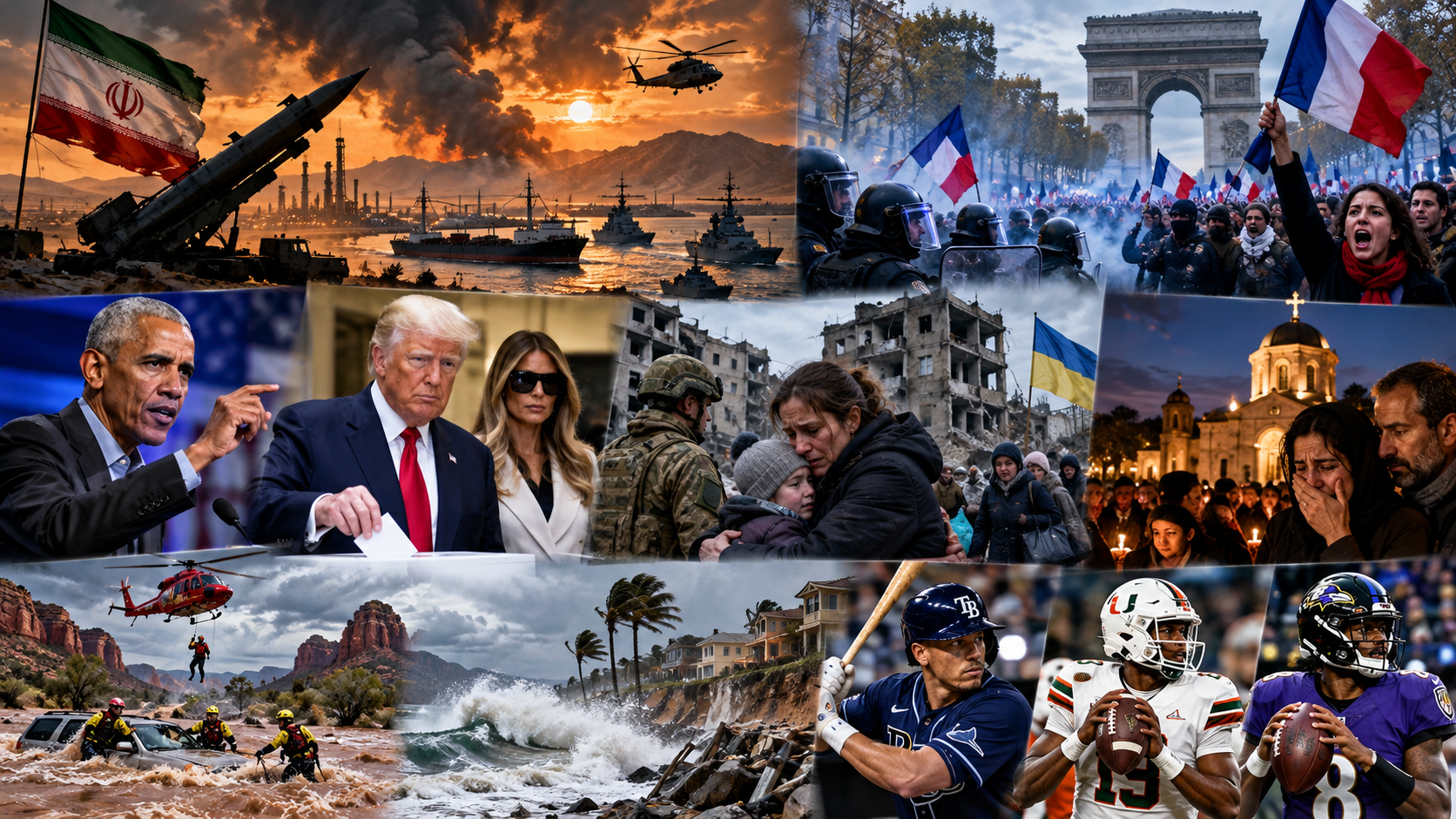
American intelligence officials are warning that Iranian plots targeting U.S. personnel abroad have reached advanced stages, raising the possibility of another dangerous escalation in a war already affecting international security and American household budgets. In France, hundreds of thousands of demonstrators filled the streets, with largely peaceful protests giving way to violent confrontations as evening approached. And here at home, former President Barack Obama and President Donald Trump were both active in the final stretch of the midterm campaigns, as new federal election disputes emerged.
We also have important developments involving survivors of clergy sexual abuse, a humanitarian breakthrough in Ukraine, severe weather threatening American communities, and an exciting Saturday of sports, including Game 2 of the World Series.
And before we say goodnight, we’ll recognize two Americans whose extraordinary courage during a deadly school shooting in Oregon helped prevent an even greater tragedy.
Let’s get caught up on where things stand.
TONIGHT: TOP STORY
U.S. Intelligence Warns Iranian Plots Against Americans Have Reached Advanced Stages
The war involving Iran has entered another dangerous period, with American intelligence officials warning that Iranian efforts to target U.S. personnel and citizens abroad have intensified significantly.
According to a memorandum dated October 23 and reviewed by Reuters, Director of National Intelligence Jay Clayton warned Secretary of State Marco Rubio that Iranian plots to kill Americans have progressed beyond preliminary planning. The warning describes threats in the Middle East and other countries, suggesting the potential danger extends beyond the immediate battlefield. CIA Director John Ratcliffe was also copied on the memorandum, which was initially reported by Axios.
The warning carries immediate operational consequences. Earlier this week, the State Department ordered non-emergency government personnel and their families to leave American diplomatic missions in Saudi Arabia. Additional diplomatic staffing reductions have been undertaken or considered elsewhere in the region as officials evaluate threats from Iran and allied armed groups.
On Saturday, the State Department also updated travel advisories covering more than a dozen countries, including Saudi Arabia, Qatar, the United Arab Emirates, Iraq, and Israel.
The heightened security measures come amid attacks involving Iranian-aligned Houthi forces and mounting threats to commercial shipping. The continuing conflict has placed military forces, diplomatic personnel, civilians, and international trade routes under increasing pressure.
For Americans stationed abroad, the warnings are particularly serious. Intelligence assessments do not establish that every reported plot will be carried out, but they provide the basis for decisions about personnel security, travel restrictions, and emergency preparations.
The question confronting Washington tonight is how to protect Americans while preventing the conflict from expanding further.
Related News: Iranian President Calls for Another Attempt at Negotiations
Despite the deteriorating security situation, Iranian President Masoud Pezeshkian renewed his call Saturday for negotiations with the United States.
Speaking on Iranian state television, Pezeshkian blamed Washington for the failure of an earlier interim agreement but maintained that another effort should be made to reach a settlement. His remarks illustrate the conflicting signals emerging from Tehran, where officials continue threatening a forceful response to renewed American military action while the country’s president publicly advocates another attempt at diplomacy.
President Trump has also left open the possibility of either renewed military action or a negotiated agreement. During campaign appearances, he has emphasized American military capabilities while suggesting that another confrontation could be avoided if Tehran agrees to terms acceptable to Washington.
No new agreement was announced Saturday.
Shipping Threats Raise Concerns About Global Trade
The Strait of Hormuz remains one of the most consequential areas of the conflict.
Attacks on commercial vessels, maritime security warnings, and American restrictions affecting Iranian shipping have increased uncertainty along an essential international energy corridor. Iranian officials have also reportedly developed contingency plans involving undersea communications infrastructure should American and Israeli attacks resume. Those plans have not been established as an operational order.
The implications extend far beyond the Middle East. International shipping disruptions can affect energy availability, freight expenses, manufacturing costs, and the prices consumers eventually pay. For the United States, the economic consequences are arriving at an especially difficult time, with congressional elections approaching and many families already struggling with higher living expenses.
The Iran conflict remains tonight’s principal international story because its consequences are military, diplomatic, economic, and increasingly personal.
TONIGHT: WORLD NEWS
France: 410,000 Demonstrators Take to Streets as Violence Erupts
France experienced another extraordinary day of demonstrations Saturday, with approximately 410,000 people participating nationwide, according to the French Interior Ministry.
Labor organizations estimated participation at nearly twice that number. In Paris alone, authorities counted approximately 110,000 demonstrators, many protesting rising living costs, inequality, deteriorating school conditions, and pressure on public services.
Much of the day’s activity remained peaceful. However, the situation deteriorated as evening approached, with violent confrontations involving groups of demonstrators and police in several cities.
In Paris, riot police used tear gas and water cannons against groups throwing objects and fireworks. Additional clashes occurred in Marseille, where young protesters erected makeshift barricades, set rubbish bins ablaze, and confronted police.
Authorities deployed approximately 70,000 police officers and gendarmes nationwide, an increase of 10,000 over the previous weekend’s operation.
Reports later in the day described arrest totals approaching 1,000, although the final nationwide figure remained subject to confirmation.
The scale of participation demonstrates that the demonstrations involve considerably more than isolated groups engaging in violence. Students, teachers, workers, labor organizations, and other citizens have joined protests over economic conditions and government policy.
The unrest has become a significant political challenge for President Emmanuel Macron and his administration.
For France, the immediate question is whether authorities can maintain public order without allowing the underlying grievances to remain unresolved.
The country faces another uncertain night.
Jordan: King Orders Forceful Response Following Church Massacre
Jordanian authorities intensified security operations Saturday following Friday’s deadly shooting at a Greek Orthodox church in the Karak governorate.
Gunmen opened fire during a funeral service, killing seven people and wounding approximately 40 others, according to the casualty figures reported by Reuters. Jordan’s King Abdullah II ordered a forceful response, directing security authorities to pursue those responsible.
Security measures were increased around diplomatic missions, shopping centers, and other public locations.
The shooting has deeply disturbed a country where attacks against Christian religious gatherings are relatively uncommon. Authorities described the incident as terrorism, but investigators had not established responsibility by a particular organization.
The attack also highlights the vulnerability of civilian gatherings during periods of heightened regional tension.
The victims were attending a funeral, a moment when families and communities ordinarily come together to mourn. Instead, they became victims of another act of deadly violence.
The investigation and search for those responsible remain active.
West Bank: Israeli Military Operation Displaces Approximately 1,200 Palestinians
Israeli military operations in the occupied West Bank have displaced approximately 1,200 Palestinians from their homes in Hebron.
The operation followed a deadly attack involving Israeli military personnel, adding another dimension to the continuing confrontation in the region.
Families affected by the operation face immediate uncertainty about shelter, security, and access to their homes. The displacement is especially significant because it involves civilians living in an area already affected by years of restrictions, political conflict, and military activity.
The humanitarian consequences will depend on how long residents remain displaced, the conditions under which they are permitted to return, and whether additional operations occur.
The development comes as the wider Middle East remains under severe military and diplomatic pressure.
Ukraine: Ceasefire Agreement and Prisoner Exchange Offer Humanitarian Progress
Amid the continuing devastation of Russia’s war in Ukraine, two significant humanitarian developments have emerged.
Russia and Ukraine have agreed to a localized ceasefire in the Russian-occupied town of Oleshky, scheduled to begin October 29. The arrangement was negotiated with the involvement of U.S. First Lady Melania Trump and is intended to allow humanitarian assistance into the community while providing a temporary opportunity for civilian evacuations.
According to the White House, approximately 1,700 to 2,000 residents remain in Oleshky, many of them elderly and facing shortages of essential supplies, including food, medicine, electricity, and clean water.
The agreement does not constitute a nationwide ceasefire. Fighting continues elsewhere, and the broader conflict remains unresolved.
Separately, Russia and Ukraine completed a major prisoner exchange Friday, returning 270 people to each side.
The exchange included military personnel and civilians who had been separated from their families, in some cases for years. Ukrainian President Volodymyr Zelenskyy said nine civilians were among those returned to Ukraine, while Russian officials also reported the return of civilians alongside military personnel.
For 540 people, the exchange meant an opportunity to leave captivity and begin returning to their families.
The two countries have also indicated that additional peace negotiations could occur in November.
While neither development ends the war, both demonstrate that limited agreements remain possible even amid continuing military confrontation.
For civilians trapped in devastated communities and families awaiting the return of loved ones, those agreements can carry enormous personal significance.
Brazil Prepares for Closely Contested Presidential Election
Brazil enters Sunday facing a presidential runoff between incumbent President Luiz Inácio Lula da Silva and Senator Flávio Bolsonaro.
The candidates concluded their final debate amid sharp disagreements over living costs, corruption, and public security.
Recent polling has suggested an exceptionally close contest, with neither candidate holding a decisive advantage.
The election carries implications for Brazil’s domestic economy, political direction, and international relationships.
As Saturday concludes, the outcome remains undecided.
Brazilian voters will determine the result Sunday.
TONIGHT: NATIONAL NEWS
New York Abuse Survivors Approve $800 Million Settlement With Archdiocese
A significant development emerged Saturday in the long-running struggle for accountability involving sexual abuse within the Catholic Church.
Survivors of clergy sexual abuse approved an $800 million settlement involving the Archdiocese of New York, according to Reuters.
The agreement is intended to address claims involving approximately 1,300 survivors whose allegations have been the subject of years of litigation and institutional scrutiny.
The size of the settlement reflects the substantial legal and financial consequences of misconduct involving religious institutions and the people entrusted with positions of authority.
For survivors, financial compensation cannot undo the abuse they experienced. However, the agreement represents a consequential step in addressing claims that have often required victims to spend years seeking recognition, accountability, and restitution.
The settlement also illustrates how institutional failures can produce consequences that extend across generations.
Mississippi Police Shooting Continues Raising Accountability Questions
The resignations of two Mississippi law enforcement officials following the fatal shooting of a 1-year-old child remain an important national public-interest development.
The child was killed in June during an incident in a Walmart parking lot.
The officer involved and the city’s interim police chief subsequently resigned, according to reporting Friday.
Their departures represent administrative consequences, but do not necessarily resolve the circumstances surrounding the shooting or establish whether additional legal action is warranted.
The death of a young child during a police operation demands a complete examination of the decisions that led to the shooting.
The public has a legitimate interest in knowing what happened, whether appropriate procedures were followed, and what measures might prevent another such tragedy.
TONIGHT: COURT BEAT
Alaska Election Lawsuit Raises Extraordinary Questions About Federal Authority
An unusual Justice Department lawsuit concerning Alaska’s Senate election continues attracting attention as the November 3 midterms approach.
The federal government is seeking the possibility of preventing certification of the election under circumstances involving alleged voter confusion.
Republican incumbent Senator Dan S. Sullivan faces Democrat Mary Peltola and another candidate, Dan J. Sullivan Jr.
The Justice Department contends that the similarity between the candidates’ names could mislead voters and influence the result. The competing candidate denies that his candidacy was designed to create confusion.
Alaska’s judicial system previously addressed questions concerning his eligibility to appear on the ballot.
President Trump publicly supported the federal lawsuit.
Republican Senator Lisa Murkowski of Alaska criticized the Justice Department’s action, while election law specialists questioned whether federal law permits the relief being requested.
The case raises important questions about the division of authority between state election administrators and the federal government.
As of the reporting reviewed for tonight’s edition, the lawsuit had not produced an established order preventing certification.
The case remains a significant development to watch.
Justice Department Challenges California Over Thousands of Voter Registrations
A separate election confrontation is developing in California, where the Justice Department is demanding additional verification of voter eligibility in several counties.
Federal officials have identified approximately 20,000 registrations they believe warrant scrutiny over possible noncitizenship. The department has sought records and demanded that election authorities segregate certain ballots while citizenship questions are examined.
The demands extend to at least 18 California counties, with officials being asked to respond within 48 hours.
California election officials have challenged the reliability of the federal government’s information.
Their objections include concerns that some individuals identified by federal authorities may be American citizens or people whose voter registrations have already been canceled.
The dispute has produced litigation involving federal election oversight, state administration of elections, and the protection of eligible voters.
The distinction between a suspected registration discrepancy and an established case of unlawful voting is essential. An individual appearing on a government list does not automatically establish that the person voted illegally.
The developing confrontation comes as ballots are already being processed for the November election.
Together, the Alaska and California disputes illustrate how election administration has become a major legal battleground even before Election Day.
Former FBI Officials Face Charges Concerning Congressional Testimony
Two former senior FBI officials face federal charges alleging they made false statements to Congress concerning their knowledge of investigations involving Hunter Biden.
The charges were disclosed in court documents made public Friday.
Prosecutors allege that the officials provided inaccurate information during congressional proceedings.
The defendants retain the presumption of innocence, and the government must prove the allegations in court.
The case adds another politically consequential dispute to the federal judicial system.
TONIGHT: WHITE HOUSE
Trump Casts Early Vote as Midterm Campaign Intensifies
President Donald Trump and First Lady Melania Trump cast their ballots Saturday in West Palm Beach, Florida, taking advantage of the state’s early voting period ahead of the November 3 elections.
The president told reporters that he voted for Republican candidates.
His decision to vote early attracted attention because he has frequently criticized certain forms of early and mail-in voting, even as Republican campaign organizations increasingly encourage supporters to cast ballots before Election Day.
Trump’s appearance also provided another opportunity to discuss the approaching election, the administration’s foreign policy, and the continuing legal dispute involving Alaska’s Senate race.
After voting, the president continued his campaign activities.
The appearance was another indication of how seriously the White House is approaching the elections that will determine congressional control.
Trump Administration Confronts Security Threats Abroad and Economic Pressure at Home
President Trump faces two increasingly connected challenges as Saturday draws to a close.
Abroad, the administration is responding to intelligence warnings involving Iran, threats to American personnel, and insecurity affecting Middle Eastern diplomatic missions.
At home, voters are increasingly concerned about the financial consequences of the conflict.
Diesel prices, heating expenses, transportation costs, and the broader cost of living are becoming major campaign issues.
The administration has introduced measures intended to provide economic relief, including assistance for agricultural producers.
However, the international conditions contributing to higher fuel costs remain unresolved.
The White House must therefore balance its military and diplomatic objectives against growing domestic economic pressure.
Trump Raises Possibility of Relocating White House Press Corps
President Trump also said Saturday that he may move the White House press corps.
The proposal raises questions about the working arrangements and access available to journalists who cover the presidency.
White House reporting depends on journalists being able to observe government activity, question officials, and provide independent accounts of presidential decisions.
No completed relocation was established by the president’s remarks.
The significance of the proposal will depend on what changes are formally introduced and how they affect press access.
TONIGHT: CAPITOL
Congressional Control Remains Central to November Elections
The November 3 elections will determine whether Republicans retain control of Congress or Democrats regain power in one or both chambers.
Republicans currently hold narrow majorities.
The results will affect President Trump’s ability to advance legislation, secure funding priorities, and maintain congressional support for his administration.
A change in control would also affect congressional oversight and the ability of lawmakers to investigate executive branch decisions.
Economic concerns have become increasingly prominent in competitive congressional districts.
For voters, the questions frequently involve the cost of housing, fuel, groceries, healthcare, and everyday necessities.
The election will also serve as a major political assessment of the administration’s first two years.
SPECIAL FEATURE: MIDTERM COVERAGE
Obama Returns to Campaign Trail and Condemns Ramaswamy Advertisement
Former President Barack Obama returned to the campaign trail Saturday, appearing in Cleveland, Ohio, to support Democratic gubernatorial candidate Dr. Amy Acton and U.S. Senate candidate Sherrod Brown.
Obama delivered a sharp critique of Republican gubernatorial candidate Vivek Ramaswamy, concentrating particular attention on a controversial campaign advertisement featuring Acton’s estranged mother.
The advertisement includes accusations about Acton’s personal character and childhood accounts.
Acton has publicly described experiencing childhood abuse, neglect, and housing instability. Her brother has also criticized the advertisement, accusing Ramaswamy’s campaign of exploiting painful family experiences for political purposes.
The advertisement has drawn criticism beyond Democratic political circles, with questions raised about the appropriateness of using a candidate’s childhood trauma in campaign attacks.
Ramaswamy’s campaign subsequently shortened the advertisement.
Obama used the controversy to question Ramaswamy’s judgment and suitability for public office, arguing that some political tactics cross basic standards of decency.
Acton also addressed the matter directly during the rally, telling supporters that her childhood experiences motivated her commitment to medicine and public service.
Ohio’s gubernatorial contest has become increasingly competitive, while Brown’s Senate campaign adds further national significance to the state.
Obama’s appearance reflects the Democratic Party’s effort to mobilize voters in places where Republican candidates have enjoyed considerable success in recent elections.
Trump Votes Early and Urges Republican Participation
President Trump’s decision to cast his ballot Saturday reinforces the Republican Party’s emphasis on maximizing voter participation.
The president continues urging supporters to approach the midterms as a direct referendum on his administration, even though his own name is not on the ballot.
Historically, the party holding the presidency has often faced substantial political challenges during midterm elections.
Republicans are attempting to overcome those difficulties through voter mobilization, early voting, and an aggressive schedule of presidential campaign appearances.
Democrats are pursuing their own turnout operations, emphasizing household affordability, government accountability, and opposition to administration policies.
Harris Returns as Democrats Mobilize Voters
Former Vice President Kamala Harris has returned to the campaign trail as Democrats seek to regain congressional control.
Her appearances have also revived discussion of the party’s leadership heading toward the 2028 presidential election.
In Michigan and other competitive states, Democrats are working to build coalitions among voters who sometimes disagree sharply on international issues.
Affordability and household finances are emerging as potential areas of common ground.
The party’s immediate challenge remains voter turnout and success in competitive congressional races.
Iran War and Rising Prices Shape Congressional Campaigns
International conflict is becoming an increasingly important issue in the final days of the American midterm campaigns.
The war involving Iran has affected global energy markets and contributed to economic pressures facing American consumers.
Republican candidates are defending the administration’s foreign policy while seeking to reassure voters about rising household expenses.
Democrats are attempting to connect those expenses with decisions made in Washington.
The result is a campaign environment in which foreign policy and domestic affordability are becoming inseparable.
Federal Election Lawsuits Add Uncertainty Before November 3
Legal disputes in Alaska and California have introduced additional controversy into the final days of the election campaign.
In Alaska, federal officials are challenging the potential certification of a Senate election result involving candidates with similar names.
In California, the Justice Department is demanding additional verification of voter eligibility and challenging the handling of ballots associated with suspected registration discrepancies.
Both matters involve unresolved legal questions.
Neither dispute establishes that the approaching elections have been decided improperly or that the government’s allegations have been proven.
The cases will nevertheless be closely watched because of their potential implications for election administration and voter confidence.
TONIGHT: ECONOMY & BUSINESS
Higher Prices Continue Squeezing American Households
The cost of living remains one of the most significant economic concerns facing American families.
Energy prices have been particularly sensitive to developments involving Iran, affecting transportation, heating, manufacturing, and agricultural operations.
Higher diesel expenses increase costs for businesses responsible for moving goods throughout the country.
Those expenses can eventually reach consumers through higher retail prices.
Households already dealing with elevated food, housing, and utility costs have limited room to absorb additional increases.
The approaching winter adds urgency in regions where heating expenses represent a major portion of household budgets.
Farmers Await $8 Billion in Diesel Assistance
The Trump administration’s $8 billion diesel assistance initiative for farmers is expected to begin distributing payments after the November 3 elections.
A Department of Agriculture official indicated Friday that the precise payment schedule remains under development, with disbursement potentially occurring near the end of the year.
The assistance is intended to offset unusually high fuel expenses affecting agricultural production.
Farmers rely on diesel-powered machinery for harvesting, planting, transportation, and numerous other operations.
Government assistance may provide relief, but uncertainty about payment timing complicates financial planning for agricultural businesses.
Energy Markets Remain Vulnerable to Middle East Developments
Continuing military threats and attacks affecting Middle Eastern shipping routes are contributing to uncertainty in international energy markets.
The Strait of Hormuz remains particularly important because of its role in global petroleum transportation.
Disruptions affecting shipping, production, or regional infrastructure can influence fuel costs far beyond the countries directly involved in the conflict.
The immediate impact on American consumers depends on energy market conditions, transportation expenses, and the duration of disruptions.
For households and businesses, the consequences remain an important part of the broader economic picture.
TONIGHT: HEALTH & SCIENCE
Artificial Intelligence Opens New Possibilities for Medical Research
Artificial intelligence continues to expand its role in biomedical research, including efforts to identify potential new uses for existing medications.
Organizations such as Every Cure are developing computational systems that examine relationships among diseases, biological mechanisms, and approved drugs.
This approach, known as drug repurposing, investigates whether medications already used for one condition may also prove useful against another.
The strategy offers potential advantages because researchers may already possess substantial information about a medication’s properties and established clinical uses.
However, predictions generated by artificial intelligence are not proof that a proposed treatment works.
Laboratory research, medical evaluation, and appropriate clinical testing remain necessary.
The growing field illustrates how computational technology is changing the way researchers search for potential treatments, particularly for rare diseases that receive comparatively limited research investment.
AI-Discovered Software Vulnerabilities Raise Cybersecurity Concerns
Cybersecurity professionals are warning that artificial intelligence may accelerate the discovery of weaknesses in computer software.
The same technology that helps developers identify defects could also allow malicious actors to locate vulnerabilities more efficiently.
This creates challenges for companies, government agencies, healthcare providers, and other organizations that depend on interconnected digital systems.
Security specialists are increasingly concerned about how quickly vulnerabilities may be discovered and exploited.
The practical response involves maintaining software updates, strengthening security practices, and addressing known weaknesses before attackers can exploit them.
Artificial intelligence offers defenders new capabilities, but it is also changing the threat environment.
TONIGHT: NATIONAL PUBLIC SAFETY
Southwest Flooding Forces Emergency Rescues
Dangerous weather continues affecting portions of the American Southwest, where heavy rainfall has already caused flooding, evacuations, and emergency rescues.
Near Sedona, Arizona, emergency crews rescued four people stranded on the roof of an SUV that had been swept downstream by floodwater.
A helicopter was used to reach the stranded occupants and bring them to safety.
Elsewhere, authorities reported rescuing approximately 30 residents from flooded homes in the Navajo Nation community of Dennehotso.
Parts of New Mexico and Colorado remain particularly vulnerable because additional rainfall can aggravate already elevated rivers and saturated ground.
The National Weather Service has identified continued flash-flood risks extending into portions of the southern and central High Plains.
Flooded roads remain a serious danger, particularly after dark, when water depth and roadway damage can be difficult to recognize.
Residents in affected areas should continue following official emergency instructions.
National Security Concerns Extend Beyond the Battlefield
The State Department’s expanded travel warnings concerning Middle Eastern countries are also a public safety development for Americans living, working, or traveling abroad.
The intelligence warning involving Iranian plots has prompted additional precautions at diplomatic missions.
Travelers should evaluate current official advisories before making plans involving affected countries.
The warnings reflect a rapidly changing security situation in which military developments can produce immediate consequences for civilians and diplomatic personnel.
WEATHER TONIGHT & TOMORROW
Southwest Storm System Moves Toward the High Plains
The principal inland weather concern overnight remains a slow-moving storm system affecting the Southwest and southern Rockies.
According to the National Weather Service, additional showers and thunderstorms may develop across parts of New Mexico, Colorado, West Texas, and neighboring areas.
The threat includes localized heavy rainfall and flash flooding, particularly where the ground is already saturated.
Some higher mountain elevations also face accumulating snowfall.
Conditions remain especially hazardous around flooded roads, low-water crossings, and areas affected by recent runoff.
California Coastal Flood Warning Begins Sunday
Southern California faces a separate coastal flooding threat beginning Sunday morning.
The National Weather Service has issued a coastal flood warning for coastal portions of San Diego and Orange counties, effective from 5 a.m. Sunday through Thursday afternoon.
Exceptionally high tides are expected to increase the risk of flooding along vulnerable shorelines.
Forecasters warn that low-lying roads, homes, businesses, and other infrastructure could experience flooding, while erosion threatens portions of the coast.
The tides may reach approximately 1 to 1.7 feet above predicted levels.
Residents living near vulnerable coastal areas should prepare for possible road closures and avoid driving through flooded streets.
The warning is particularly important because flooding may occur even without heavy rainfall directly over affected neighborhoods.
South Florida Faces Coastal Flooding and Heavy Rain
Florida’s southeastern coastline is also facing a developing combination of high tides, strong winds, dangerous surf, and heavy rainfall.
The National Weather Service office in Miami warns that moderate coastal flooding is expected during high-tide cycles, with major flooding possible late Sunday into early next week.
Heavy rainfall could create additional flooding problems in urban areas where drainage is already affected by elevated coastal water levels.
Wind gusts exceeding 35 mph are possible Sunday and Monday.
Dangerous surf and rip currents are also expected along Atlantic beaches.
Residents and visitors should follow local coastal warnings and avoid entering dangerous surf.
Eastern United States Sees Seasonal Autumn Conditions
Elsewhere, much of the eastern United States is experiencing more typical autumn conditions.
Temperatures vary across the region, with cooler overnight readings in portions of the Northeast and generally milder conditions farther south.
Looking toward the coming week, forecasters expect above-average warmth to expand across substantial portions of the eastern United States.
Residents should consult local forecasts for frost advisories, precipitation, and changing temperatures.
OVERNIGHT & TOMORROW
Brazil Votes Sunday
Brazilian voters will decide their presidential runoff between Luiz Inácio Lula da Silva and Flávio Bolsonaro.
The outcome remains uncertain following a close campaign.
France Assesses Another Day of Major Unrest
French officials will continue reviewing Saturday’s demonstrations, arrests, injuries, and property damage.
The government’s response and the organizers’ next steps will help determine whether the protests continue into another week.
Iran Conflict Remains Under Close Watch
American diplomatic security measures and developments involving Iranian-aligned armed groups remain important overnight concerns.
No verified order for a new American military campaign has been established in the reporting used for tonight’s edition.
California and Florida Prepare for Coastal Flooding
Coastal communities in Southern California and southeastern Florida face increasing flooding concerns heading into Sunday.
Official weather warnings identify potential threats to low-lying roads, businesses, homes, and shoreline infrastructure.
Midterm Campaigns Enter Their Final Full Week
With November 3 approaching, candidates across the country are preparing for the final full week of campaigning.
Energy costs, government accountability, international security, and household affordability remain prominent election issues.
TONIGHT: SPORTS
World Series: Rays and Brewers Battle in Game 2
Baseball’s biggest stage belongs to the Tampa Bay Rays and Milwaukee Brewers tonight as the teams continue the 2026 World Series at American Family Field in Milwaukee.
The Brewers entered Saturday holding a 1-0 series lead after defeating Tampa Bay 3-2 in Friday night’s opener.
Milwaukee’s victory featured an impressive pitching performance by Jacob Misiorowski and a dramatic ninth inning in which the Rays threatened to rally before the Brewers secured the final out.
Game 2 began Saturday evening with Drew Rasmussen taking the mound for Tampa Bay against Milwaukee rookie Logan Henderson.
Early in Saturday’s game, the Rays moved ahead 4-2 in the third inning.
The score represented an in-progress game, not a final result.
For Tampa Bay, the objective is to even the series before the teams move to Florida. Milwaukee is attempting to capitalize on its home-field advantage and take a commanding two-game lead.
College Football: No. 1 Miami Dominates Pittsburgh
The nation’s top-ranked college football team delivered another commanding performance Saturday.
No. 1 Miami defeated Pittsburgh 52-23, with quarterback Darian Mensah throwing for 387 yards and four touchdowns.
The Hurricanes entered the game ranked first nationally for the first time since 2002, adding significance to a matchup that already carried considerable attention.
Miami’s explosive offense overwhelmed Pittsburgh and reinforced the program’s position among this season’s leading championship contenders.
The victory also provided another major statistical performance for Mensah, whose passing production continues attracting national attention.
Indiana Survives Overtime Battle at Michigan
No. 6 Indiana escaped Michigan with a 13-6 overtime victory Saturday, ending a long stretch of road frustration against the Wolverines.
The Hoosiers secured their first victory at Michigan since 1967.
The result came in a defensive struggle in which neither team generated much offensive production during regulation.
Indiana ultimately prevailed in overtime, adding an important victory to its season while keeping its championship aspirations alive.
For Michigan, the defeat represents another setback in a season marked by difficult competition.
Cincinnati Upsets No. 8 Texas Tech
One of Saturday’s biggest surprises came in Cincinnati, where the Bearcats defeated No. 8 Texas Tech 37-24.
The result disrupted the national rankings and delivered a significant setback to a Texas Tech team entering the weekend among the country’s top contenders.
Cincinnati’s victory adds another complication to the crowded national championship picture.
For the Bearcats, defeating a top-10 opponent provides a major achievement and a result that could influence the remainder of the conference race.
LSU and SMU Deliver Convincing Victories
No. 18 LSU defeated Auburn 38-17, delivering a strong performance against a Southeastern Conference opponent.
The Tigers controlled the matchup and secured a victory that strengthens their position heading into the final stretch of the regular season.
Meanwhile, No. 23 SMU overwhelmed California 59-20.
The Mustangs produced an explosive offensive performance and added another convincing result to their season.
Elsewhere, college football’s national picture continued shifting as ranked teams faced difficult conference opponents and several contenders suffered unexpected defeats.
NFL Week 8: Injuries Create Uncertainty Ahead of Sunday’s Games
The National Football League prepares for another important Sunday with several teams facing difficult lineup decisions.
In New York, the Giants are dealing with injuries affecting multiple defensive players and offensive personnel ahead of their matchup against the Houston Texans.
The team’s injury reporting has included concerns involving tight end Theo Johnson and safety Jevón Holland.
Other franchises are also evaluating quarterback availability and offensive depth as the season approaches its midpoint.
For teams competing in closely contested divisions, the absence of a starting quarterback or key defensive contributor can materially affect game plans.
Coaches will continue adjusting lineups based on final injury designations.
Sunday’s games will provide another important measure of which teams are positioned to compete for playoff opportunities as the season advances.
THAT’S WHAT’S UP
A Carpenter, a Teacher, and the Courage That Saved Children in Oregon
Sometimes heroes don’t wear uniforms, carry badges, or arrive with flashing lights and sirens. Sometimes they’re ordinary people who find themselves facing an unimaginable situation and make a decision that could cost them their lives.
On October 15, 2026, at Silver Rail Elementary School in Bend, Oregon, a 16-year-old gunman armed with a shotgun forced his way into the building and opened fire inside a special education classroom. Three children, ages 5, 8, and 11, and a 25-year-old teacher were killed. Two others were wounded. It was a tragedy that devastated families and left an entire community grieving.
But amid that horror, two people demonstrated extraordinary courage.
Inside the classroom, an unarmed teacher confronted the gunman. Rather than retreat, she threw her cellphone at him, tackled him, and struggled to wrestle away his shotgun. She knew the danger. She knew what that weapon could do. And she fought anyway, placing herself directly between a killer and the children he was threatening.
Meanwhile, 36-year-old carpenter Kaylub Giamanco was passing the school where he had dropped off his two daughters earlier that morning. He witnessed the armed teenager entering the school grounds and realized something terrible was unfolding. Retrieving his legally owned handgun from his truck, Giamanco called 911.
He told the dispatcher, “I’m sorry, I have to go in. People are going to die.”
And he went in.
Giamanco entered through shattered glass and followed the sounds of gunfire until he reached the classroom. There, he saw the teacher still struggling with the attacker. He confronted the gunman and fired, ending the attack before more children could be killed.
Investigators later recovered the shotgun and 44 rounds of ammunition associated with the attacker. Police credited the teacher and Giamanco with actions that likely prevented additional deaths.
But what makes this story especially remarkable is what Giamanco said afterward.
He doesn’t consider himself a hero.
Despite saving lives, the father of two has struggled with the knowledge that four innocent people died before he could intervene. He has spoken about the children he couldn’t save and the tremendous emotional weight of what happened.
And rather than seek recognition for himself, Giamanco has directed attention toward the teacher who fought the attacker with nothing more than her courage and determination to protect her students.
Think about that for a moment.
A carpenter who had every reason to protect his own life entered a building where a gunman was killing children. A teacher with no weapon confronted that gunman because the children entrusted to her care were in danger. Neither had time to prepare for what happened. Neither knew whether they would survive.
Yet both acted.
Four innocent lives were lost that day, and nothing can diminish that tragedy or the grief carried by their families. But the actions of these two Americans ensured that the devastation did not become even greater.
Tonight, NewsXR recognizes Kaylub Giamanco and the courageous teacher of Silver Rail Elementary School.
Not because they sought recognition, but because when innocent children needed someone to stand between them and death, these two extraordinary Americans did exactly that.
And somewhere in Oregon tonight, there are families who still have their children because they did.
That’s what’s up, America.
Goodnight from all of us at NewsXR. God bless you all, and us too, and please keep inspiring! ❤️ Amen.


© 2026 NewsXR. All Rights Reserved.