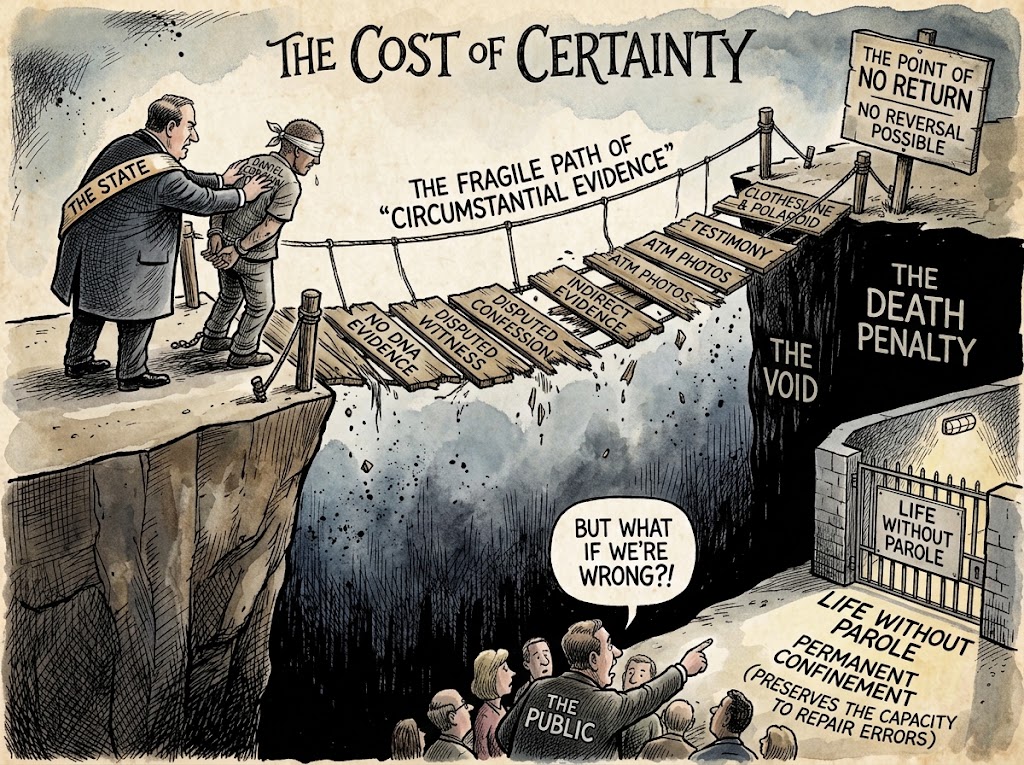
The Cost of Certainty: Why Circumstantial Convictions Demand Life, Not Death
Florida executed Daniel Conahan on September 10, 2026, for the kidnapping and murder of Richard Allen Montgomery. The state has carried out its sentence. The man authorities suspected in the “Hog Trail” killings is dead, and the opportunity to choose a different punishment is gone. We think justice was served. We certainly hope so. Given the brutality of Montgomery’s death and the evidence presented against Conahan, there is every human reason to want to believe the system reached the right conclusion. But we may have gotten this one wrong entirely. That possibility is not a declaration of his innocence. It is the dilemma that lives within the hypotheticals of a circumstantial case: we can find the accumulated evidence convincing, accept the verdict, and still have to acknowledge that the explanation we accepted could be wrong. Florida has now made the consequences of that possibility irreversible. Associated Press
Conahan’s conviction rested on a substantial circumstantial case. The record included purchases of clothesline and Polaroid film, ATM photographs, paint evidence, and testimony describing a similar assault. The Florida Supreme Court’s September 2026 opinion acknowledged that no recovered crime-scene items contained Conahan’s DNA, while concluding that the combined evidence supported his conviction and sentence. Those circumstances cannot honestly be dismissed as nothing. They also cannot be transformed into infallibility simply because a court found them sufficient. Our objection begins at that distinction: evidence sufficient to sustain a conviction does not automatically settle whether the government should impose a punishment it can never undo. Florida Supreme Court opinion
The witness evidence requires the same discipline. Stanley Burden testified about an earlier attack; he did not witness Montgomery’s murder. Floridians for Alternatives to the Death Penalty reported that Burden later acknowledged promised support for parole, and that another prisoner disputed jailhouse informant John Neuman’s account of an alleged confession. These are attributed challenges, not findings that the prosecution fabricated its case. They nevertheless identify the concern that belongs at the center of this discussion: when testimony is disputed and a witness may benefit from cooperation, the state must confront how those incentives could affect the account it asks a court to believe. Floridians for Alternatives to the Death Penalty
We should not need proof of a secret bargain before recognizing why such arrangements demand scrutiny. A witness’s expectation of help can matter even when no signed agreement exists. That does not establish that the witness lied. It establishes why confidence in the witness must be examined rather than assumed. Where a prosecution depends on connecting physical circumstances with contested human accounts, the possibility of error remains a matter of public responsibility. The seriousness of the crime makes that responsibility greater.
Florida could have preserved the punishment without making a possible mistake permanent.
Life without parole would have respected the verdict, kept Conahan confined, and preserved the possibility of meaningful relief if the conviction were later overturned. That was a severe punishment available to a state determined to protect the public. It would not have required officials to declare him innocent or dismiss Montgomery’s suffering. It would have required them to acknowledge that a justice system administered by human beings must retain some capacity to repair what human beings get wrong.
Execution eliminated that capacity in the most consequential sense. The record can still be investigated. Evidence can still be reexamined. A future finding could still change the public understanding of this case. But no finding can restore Conahan’s life. This is the failure we are criticizing after the fact: Florida chose a punishment that foreclosed a living remedy when permanent confinement could have preserved both public protection and the possibility of correction.
Contextualizing the History: Precedents, Pitfalls, and Regional Variations
1. Residual Doubt: What the Law Permits and What Responsibility Demands
The distinction between legal guilt and lingering uncertainty has appeared repeatedly in capital punishment litigation. In Franklin v. Lynaugh in 1988, the Supreme Court rejected the claimed entitlement to the requested treatment of residual doubt at sentencing. In Oregon v. Guzek in 2006, the Court explained that its precedents had not established an Eighth Amendment right to introduce sentencing evidence designed to cast residual doubt on the underlying conviction. We should therefore be precise: lingering doubt is not a universal constitutional prohibition against execution. Our position is that it should carry greater weight in deciding whether execution is justified. Oregon v. Guzek, discussing Franklin
That is a criticism of the standard the government applies, rather than a claim that an existing rule automatically required a different result. A state can satisfy its legal procedures and still make a decision worthy of condemnation. The fact that an execution survived appellate review tells us what the courts permitted. It does not relieve the public of deciding whether the punishment was necessary, proportionate, or responsible in light of the uncertainty that remained.
Nor should we pretend that direct evidence is automatically unassailable. An eyewitness can be mistaken. A confession can be false. Circumstantial evidence can be exceptionally strong. Our argument for life sentences in circumstantial capital cases must rest on the danger of irreversible punishment, rather than an artificial claim that one category of evidence is always reliable and another always defective. When guilt depends on reconstructing events through inference and disputed testimony, the government should preserve the opportunity to act on a later correction.
2. Kirk Bloodsworth: What a Wrongful Conviction Leaves Behind
Kirk Bloodsworth’s case demonstrates why that opportunity matters. In 1985, he was convicted and sentenced to death in Maryland for the rape and murder of nine-year-old Dawn Hamilton. Witness identifications helped secure the conviction. After that conviction was overturned, he was convicted again in 1987 and sentenced to life. DNA testing eventually excluded him, and he was released in June 1993 and pardoned on the basis of innocence that December. He became the first person in the United States exonerated by DNA after having been sentenced to death. Innocence Project case record
Bloodsworth’s exoneration does not establish Conahan’s innocence, and the cases should not be presented as identical. Its relevance is more fundamental. A conviction that survived a courtroom’s scrutiny proved wrong when better evidence became available. The institution’s confidence did not protect Bloodsworth from wrongful imprisonment. His survival preserved the possibility that the error could be exposed and that he could experience freedom again.
We cannot return the years a wrongly convicted person spends in prison. That injury is real even when an exoneration follows. But the difference between an imprisoned person who can be released and an executed person who can only be vindicated posthumously is enormous. Any serious assessment of capital punishment has to account for that difference before the execution, because afterward the state can offer acknowledgment without restoration.
3. Regional Variations: Different Procedures, the Same Irreversible Consequence
Capital sentencing rules vary across jurisdictions, but those differences should not be misrepresented as a general requirement for direct evidence. Florida’s current statute requires specified findings concerning aggravating factors and consideration of mitigation. Texas requires, among other findings, a determination concerning the probability of future violent conduct constituting a continuing threat to society. Federal law provides its own process for establishing and weighing aggravating and mitigating factors, including a unanimous jury recommendation for death. These are different procedures for authorizing punishment. None should be confused with a guarantee against factual error. Florida statute, Texas statute, Federal capital sentencing law
The relevant criticism is that these systems can authorize death without eliminating the possibility that a conviction will later unravel. Procedural compliance has value, but it cannot accomplish what the evidence itself does not accomplish. A state should be able to explain why permanent confinement was insufficient before choosing to extinguish the possibility of a living remedy. The horror of the offense explains the demand for severe punishment. It does not, by itself, explain why that punishment had to be irreversible.
Florida has already made its decision, and Conahan has already paid with his life. We think the state punished the right man. We hope the evidence told the truth we believe it told. But if we got this one wrong entirely, our confidence will provide no remedy, and our good intentions will return nothing. Life without parole would have enforced the verdict while preserving the ability to respond meaningfully if the evidence changed. That is why we believe it was the responsible sentence. The dilemma of a circumstantial case does not disappear when the state executes the defendant. The state simply gives up the ability to repair its gravest possible mistake.