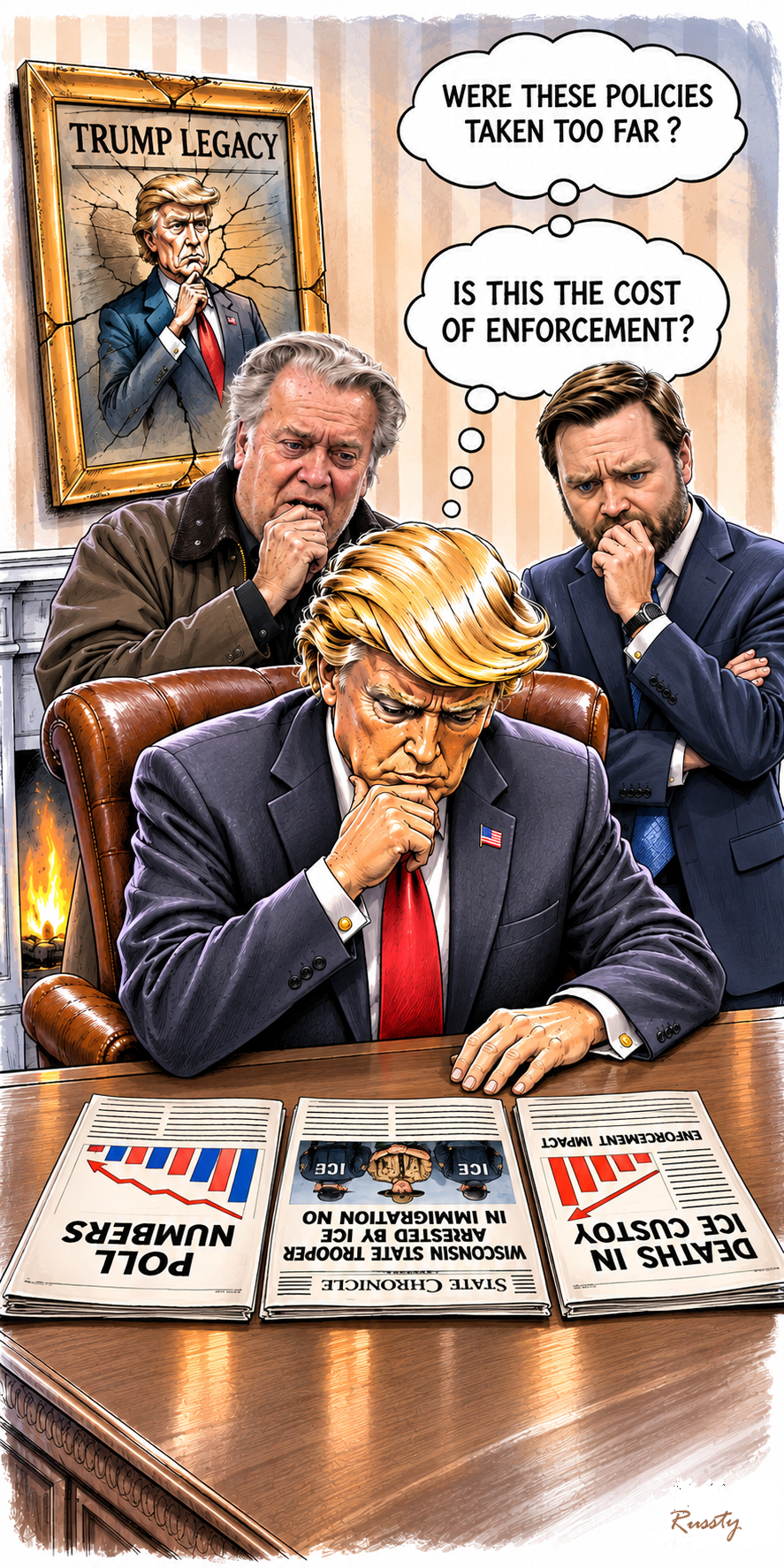
A PRESIDENT BEGINNING TO THINK ABOUT LEGACY?
By R.D. Milano
Publisher & Editor-in-Chief
NewsXR | Interactive News Network
Something interesting happened during Donald Trump’s latest 60 Minutes interview, and I believe the most important story may be larger than immigration, larger than the midterm elections, and even larger than the personnel changes now taking place inside his White House. For perhaps the first time in this presidency, I saw glimpses of a man beginning to look at his time in power not only through the question of what he can still accomplish, but through the question every two-term president eventually confronts: What will all of this mean when I am gone? The interview touched on history, succession, mortality, political setbacks and decisions Trump believes may be judged differently years from now. And in the middle of all of that reflection came one of the most surprising admissions I have heard from this President.
His immigration policy, Trump said, may have been “too tough.”
Those are only two words, but coming from Donald Trump they deserve to be taken seriously. This is a President famous for counterattacking, defending his decisions, rejecting criticism and doubling down when political opponents expect retreat. He did not renounce immigration enforcement, apologize for securing the border, or abandon his determination to remove dangerous people from the country. Instead, he did something more subtle and perhaps more meaningful: he acknowledged that the mandate he believed he received from the American people may have been executed too broadly.
Trump returned to the White House politically vindicated after a remarkable comeback. Immigration had been central to his campaign, and it is easy to understand why he believed voters had given him a mandate to act decisively where he believed previous administrations had failed. He surrounded himself with people prepared to execute that mandate aggressively, and his administration moved with extraordinary force. My concern has never been that America should not enforce its immigration laws. My concern has been whether an administration energized by victory allowed enforcement to become so sweeping that necessary distinctions between people began disappearing.
We saw one of those distinctions firsthand at NewsXR.
Just days ago, we reported the story of Wisconsin State Trooper Carel Aaron Van Der Merwe, a young man detained by ICE despite having work authorization, an unresolved immigration case and a career serving his community in law enforcement. We never argued that wearing a State Police uniform automatically settles someone’s citizenship or immigration status. What we argued was that his life, service and circumstances demanded something more thoughtful than treating him as though he were indistinguishable from the violent criminals Americans were repeatedly told this enforcement campaign was designed to remove.
That story became our way of speaking against the parts of this crackdown that simply did not seem fair.
Here was a young man who had attended school in America, built a life here, entered public service and been trusted by the State of Wisconsin to wear a badge and enforce its laws. Whatever the ultimate legal resolution of his immigration case, his detention forced a legitimate question: if someone can become sufficiently integrated into American life to serve as a State Trooper, should our immigration system not be capable of recognizing that before treating him like another number in a mass-enforcement operation? We said then that America needed a balanced immigration policy capable of distinguishing genuine public-safety threats from people whose immigration circumstances were complicated but whose lives told an entirely different story.
So imagine our pleasure when the President himself began drawing essentially that distinction.
Trump spoke about removing “the bad ones,” but then talked separately about people with jobs, people working in hotels and landscaping, people paying taxes, and people whose principal violation was entering the country illegally. That distinction matters enormously. The violent offender, the drug trafficker, the working parent, the hotel employee, the landscaper, the taxpayer and the State Trooper are not interchangeable human beings simply because immigration law may touch each of their lives.
Then Trump said the policy had been “too tough.”
For this President in particular, I consider that a stunning and welcome development.
It would have been easy for Trump to blame everyone else after the midterm elections. Presidents do it. Political parties do it. Advisers blame messaging, candidates blame turnout, activists blame establishment politicians, and everybody finds someone else responsible for the voters’ judgment. Trump did some of that too, but he also acknowledged that aspects of his immigration enforcement had hurt Republicans and may have gone farther than voters were comfortable accepting.
He also signaled that changes were coming inside his administration. Within hours of the interview, Susie Wiles was leaving as White House chief of staff and Stephen Miller was taking her place. Miller’s elevation certainly does not look like an abandonment of aggressive immigration enforcement, and that is why I would not describe what we are seeing as a policy reversal. It may instead be evidence of a President dissatisfied not necessarily with his objectives, but with some of the results, execution and political consequences produced by the people responsible for carrying them out.
That distinction could become enormously important.
A President can still believe he was right to secure the border and also admit that some deportations went too far. Those two things do not cancel each other out. Americans can expect their government to remove dangerous people without insisting that every undocumented person be treated exactly the same. There is room for judgment here, and there should be. Changing course when a policy reaches farther than intended is not abandoning the policy. It is governing.
But the 60 Minutes interview makes me wonder whether something even larger is happening.
Trump is approaching the final two years of what, constitutionally, should be his final presidency. The interview moved into subjects presidents become increasingly conscious of as the clock runs down: who comes next, how history will judge major decisions, and what remains when the presidency is over. Asked about death, Trump answered, “I hope I’m missed.” Elsewhere, he pointed to Ulysses S. Grant as an example of a President whose standing improved with history.
That does not prove legacy is driving Trump’s decisions. But it does suggest a man increasingly aware that elections eventually end and the record remains. Trump has dominated American political life for more than a decade, transformed the Republican Party, survived impeachment, criminal prosecution, assassination attempts, electoral defeat and an extraordinary return to power. His place in history is assured. What remains unsettled is how the final chapter will shape that place.
That is why the immigration admission matters beyond immigration.
A President’s record is not measured only by how aggressively he pursued an agenda. It is also measured by whether he recognized when his government went farther than necessary and had the judgment to respond. History remembers strength, but it can remember restraint too. Sometimes leadership means pushing forward. Sometimes it means recognizing when something needs to be pulled back.
I believe Trump returned to office excited by political vindication and convinced he possessed a powerful mandate. I believe that confidence contributed to putting very aggressive people in positions where they could move rapidly on his agenda. And I do not believe he always reined in the harder edges of that agenda quickly enough when legitimate enforcement began producing outcomes that appeared unnecessarily harsh.
That is my interpretation.
But now we have something we did not have before.
We have the President himself acknowledging that one of those policies may have been “too tough.”
That matters.
Our politics has become so childish that admitting second thoughts is treated as weakness. Politicians are trained never to concede, never to apologize, never to give an opponent a quotation that can be turned into a campaign advertisement. We have effectively created a political culture that rewards leaders for pretending they are incapable of mistakes.
I reject that idea.
There is humility in reconsideration.
There is honesty in looking at something you ordered, seeing how it operated in the real world and admitting that perhaps the machinery went farther than you intended.
And there can be strength in saying so.
I have criticized Donald Trump when I believed criticism was deserved. NewsXR criticized elements of his immigration policy when we believed enforcement was losing necessary balance. We used the Trooper’s story to show readers exactly what concerned us.
That makes me all the more comfortable praising him now.
If we are prepared to criticize a President when we believe he is wrong, intellectual honesty requires us to acknowledge him when he demonstrates something we believe is right.
President Trump, I was pleased to hear you say it.
Maybe it was too tough.
Maybe some people charged with executing your mandate interpreted strength as an instruction to eliminate discretion.
Maybe an administration energized by victory became so focused on proving that immigration laws would finally be enforced that it occasionally forgot to ask whether every person caught in that machinery belonged there.
And maybe, with the midterms behind you and the remaining years of this presidency becoming more precious, you are beginning to look at some of those decisions differently.
If so, I welcome it.
I would rather have a President capable of reconsideration than one imprisoned by his own pride.
I would rather hear Donald Trump say “too tough” than watch him defend every consequence simply because admitting excess might give his opponents satisfaction.
And if this is the beginning of a President placing greater weight on the consequences of his policies and the record he will ultimately leave behind, I hope Americans are willing to give him room to do it.
That does not mean giving him a pass.
It means giving him credit when credit is due.
Now comes the important part.
Turn reflection into policy.
Secure the border.
Remove the dangerous people who threaten our communities.
Enforce the law.
But restore judgment to the process. Recognize the difference between the violent offender and the working neighbor, between the drug trafficker and the taxpayer, between the genuine public-safety threat and someone like the State Trooper whose very life in public service forces us to confront how complicated immigration can become.
Donald Trump has spent much of his political career proving that he knows how to fight.
The remaining question is whether the closing years of his presidency will also show that he knows when to reconsider.
If they do, history may remember that too.
© 2026 NewsXR. All Rights Reserved. Permission to Share Granted.