
Tag: ICE

  • Release the Video. Investigate the Shooting. Stop Picking Sides.

    Release the Video. Investigate the Shooting. Stop Picking Sides.

    Release the Video. Investigate the Shooting. Stop Picking Sides.

    There is something deeply troubling about the political reaction to the ICE shooting in Marble Hill, and it goes far beyond immigration policy.

    An ICE agent fired seven rounds during an attempted arrest, striking 28-year-old Oscar Bergal in the neck while his 5-year-old son was inside the vehicle. DHS says Bergal refused commands, struck government vehicles and accelerated toward officers, placing them in fear for their lives. Publicly available video shows a chaotic encounter, but it does not clearly answer the most important question: what exactly was happening at the moment an officer decided deadly force was necessary? ICE has said its body-camera footage will be released, but has not said when.

    That video needs to come out.

    What troubles us almost as much as the delay is how quickly political leaders have chosen their conclusions. One side appears prepared to condemn the officers before the investigation is complete. The other appears prepared to defend them before the investigation is complete. Neither approach serves the public.

    Immigration enforcement is controversial. That is irrelevant to determining whether these particular officers acted responsibly.

    ICE has lawful duties to perform. Agents sometimes confront dangerous people in unpredictable situations. A moving vehicle can become a deadly weapon in seconds. If the evidence shows these officers reasonably believed they were about to be struck or killed, then that evidence should be presented and the officers should be judged accordingly.

    But popular enforcement missions do not make officers infallible either. Police officers, federal agents and correctional officers are human beings. Human beings make mistakes. They panic. They misread situations. They sometimes overreact. And occasionally they use force that cannot be justified.

    If that happened here, accountability should follow. Hold the responsible officers accountable, correct whatever failed, and let the agency move forward. Accountability for misconduct is not an attack on law enforcement. It is part of maintaining legitimate law enforcement.

    The opposite rush to judgment is equally concerning. Some people appear ready to declare the shooting criminal simply because they oppose ICE, the Trump administration or immigration enforcement generally. That is not an investigation. That is politics wearing the costume of certainty.

    We should be capable of something better than this.

    Governor, mayor, secretary, president, protester or ICE supporter, nobody should be deciding what happened according to the party line. Leaders should be demanding the evidence, reviewing the evidence and following it wherever it goes.

    A federal agent discharged a firearm seven times. A man was wounded. A 5-year-old child was sitting inside the vehicle. That deserves a legitimate investigation free from political theater.

    And right now, the most important piece of evidence remains unavailable to the public.

    Release the body-camera footage. Conduct the investigation. If the agents acted properly, say so and show us why. If they did not, hold them accountable. Then let the facts, not the politics, decide where the chips fall.
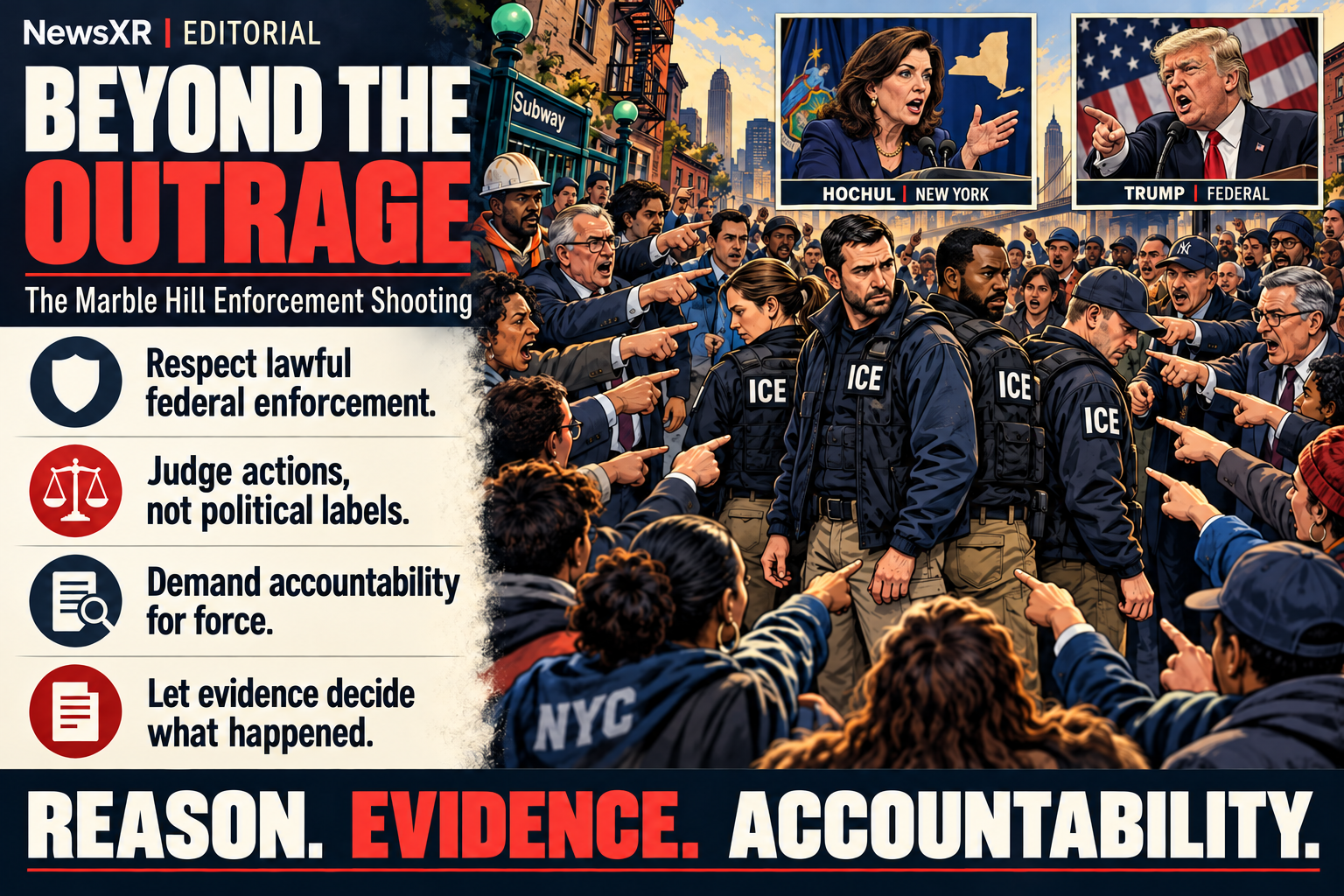
  • BEYOND THE OUTRAGE: SEEKING TRUTH AND REASON IN THE MARBLE HILL ENFORCEMENT SHOOTING

    BEYOND THE OUTRAGE: SEEKING TRUTH AND REASON IN THE MARBLE HILL ENFORCEMENT SHOOTING

    𝗕𝗘𝗬𝗢𝗡𝗗 𝗧𝗛𝗘 𝗢𝗨𝗧𝗥𝗔𝗚𝗘: 𝗦𝗘𝗘𝗞𝗜𝗡𝗚 𝗧𝗥𝗨𝗧𝗛 𝗔𝗡𝗗 𝗥𝗘𝗔𝗦𝗢𝗡 𝗜𝗡 𝗧𝗛𝗘 𝗠𝗔𝗥𝗕𝗟𝗘 𝗛𝗜𝗟𝗟 𝗘𝗡𝗙𝗢𝗥𝗖𝗘𝗠𝗘𝗡𝗧 𝗦𝗛𝗢𝗢𝗧𝗜𝗡𝗚
    ‎
    The intersection of federal immigration enforcement and local sovereignty has long been one of the most combustible fault lines in American civic life. Following the October 8 encounter in the Marble Hill neighborhood of Manhattan, where plainclothes U.S. Immigration and Customs Enforcement (ICE) agents discharged their weapons during an attempted vehicle stop, wounding a driver with a five-year-old child inside, that fault line has fractured into familiar and immediate recrimination.
    ‎
    Within hours of the incident, before a single forensic report could be compiled or a vehicle black box audited, the lines of political warfare were firmly drawn. Local municipal leaders swiftly denounced the operation as a reckless endangerment of a residential community, using the crisis to renew calls for the complete dismantling of federal immigration enforcement. Simultaneously, the Department of Homeland Security firmly defended the agents, characterizing the encounter as a textbook response to an active vehicular assault and pointing to New York’s strict sanctuary policies as the root cause of high-risk street confrontations.
    ‎
    Lost in this immediate crossfire of rhetoric is any commitment to the fundamental principles of due process, tactical clarity, and objective truth.
    ‎
    To evaluate this crisis with the reason it demands, the public must first acknowledge an institutional reality: a state or municipality does not possess the constitutional authority to rewrite national immigration policy, nor does it have the right to actively obstruct the lawful execution of federal enforcement. The U.S. Supreme Court has repeatedly affirmed that the federal government possesses exclusive, plenary power over the nation’s borders and naturalization laws. When local ordinances are weaponized to systematically frustrate federal operations or foster an environment of open defiance, it does not solve a policy crisis; it merely displaces the tension onto the civilian pavement.
    ‎
    Furthermore, the immediate blanket condemnation of these agents simply for enforcing immigration law represents a profound injustice to the men and women who serve in law enforcement. The individuals tasked with executing field operations are frequently career law enforcement professionals carrying out an incredibly difficult, legally complex, and deeply unpopular mandate. They do not draft the immigration statutes passed by Congress, nor do they dictate the administrative procedures of the executive branch. To overlay these civil servants with broad political contempt for their mission ignores the terrifying, split-second operational realities they encounter when a multi-ton vehicle begins moving in tight quarters.
    ‎
    At the same time, a strict commitment to justice demands an equally rigorous standard of accountability for federal operations, independent of any political noise. Law enforcement authority is not absolute; it is strictly bounded by the Constitution and the immutable laws of objective reasonableness. A badge does not grant a license to discharge a firearm into a vehicle simply to halt a fleeing suspect, a threshold clearly protected under both New York Penal Law and federal directives. The determination of whether this specific discharge of force was a legitimate act of self-defense or an unjustified escalation cannot be decided by a press release from the Department of Homeland Security any more than it can be decided by a press conference from the Mayor’s office.
    ‎
    As the Bronx District Attorney and federal oversight bodies proceed with concurrent investigations, the path forward requires an intentional retreat from ideological outrage. The ultimate resolution of this case will not and should not be found in the political alignment of an elected prosecutor or the defensive posture of a federal agency. It will be found in the silent, unalterable physics of the scene, specifically the ballistics trajectory mapping, the vehicle’s electronic data loggers, and the unedited operational video.
    ‎
    Immigration remains a deeply polarizing and painful national debate, but a nation governed by the rule of law cannot allow political anxiety to dictate criminal justice. The public, the state, and the agents themselves deserve an investigation anchored strictly in facts, conducted with patience, and insulated entirely from the theater of public outrage.