Iran Signals Major Escalation With Claims of Mine Blockade as Tanker Attacks and Threats of Wider War Intensify
NEWSXR INTERNATIONAL | WAR UPDATE | OCTOBER 21, 2026
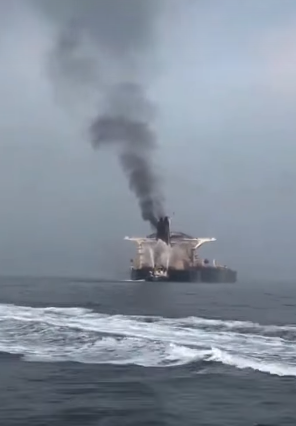
Middle East – Iran’s Revolutionary Guard is claiming that commercial oil tankers have struck naval mines while attempting to navigate the Strait of Hormuz, raising the stakes in an increasingly dangerous confrontation with the United States and Israel. The Iranian announcements come as international maritime authorities confirm separate attacks against tankers in the Persian Gulf, including a strike early Wednesday that ignited a fire aboard a commercial vessel near Oman. Tehran is warning that additional Western military action could trigger attacks against vital communications infrastructure, while Israel is reportedly pressing for renewed large-scale strikes against Iran. Across the region, the conflict is expanding through deadly missile attacks in Yemen, threats to Saudi Arabia, and growing uncertainty over whether diplomatic negotiations can prevent another major military confrontation.
Iran Claims Tankers Struck Naval Mines
Iran’s Islamic Revolutionary Guard Corps Navy announced Tuesday that three commercial tankers had struck naval mines while attempting to use shipping routes Tehran considers unauthorized. Iranian state media reported that two vessels caught fire and that a third supertanker, allegedly carrying more than two million barrels of crude oil, exploded after entering a mined area. Iranian officials accused the vessels of disabling their navigation and positioning systems to avoid detection while traveling through restricted waters. However, the Revolutionary Guard did not identify the vessels or provide independently verifiable evidence establishing that the reported explosions occurred as described.
International maritime monitoring organizations have not confirmed Iran’s latest mine claims. The Joint Maritime Information Center previously reported that similar Iranian announcements involving two supertankers on October 17 lacked substantiating evidence, and maritime security specialists continue investigating reports of possible mining activity. The distinction is significant because verified attacks against commercial shipping have continued, but those incidents have generally involved unidentified projectiles rather than confirmed underwater explosions. Iran’s announcements nevertheless represent an explicit assertion that vessels disregarding its maritime restrictions face potentially deadly consequences, whether or not the specific mine incidents are ultimately verified.
Another Tanker Struck Near Oman
While Iran’s claims remain disputed, international maritime authorities have documented two additional tanker attacks within approximately seven hours of each other. The United Kingdom Maritime Trade Operations agency reported that a tanker was struck by an unidentified projectile approximately 11 nautical miles west of Bukha, Oman, at 1:45 a.m. UTC on Wednesday, October 21. The impact started a fire aboard the vessel, which was subsequently extinguished. All crew members were reported safe, and authorities reported no environmental damage. The tanker remained at anchor following the incident, and responsibility for the attack had not been established.
A separate incident occurred Tuesday evening when another tanker was struck by an unidentified projectile approximately 30 nautical miles southeast of Al Faw, Iraq. That vessel reported no casualties, significant damage, or environmental impact. The attacks demonstrate that the danger to commercial shipping now extends beyond the Strait of Hormuz into the wider Persian Gulf. Maritime security authorities have maintained a SEVERE threat assessment for the strait and elevated the broader Persian Gulf to SUBSTANTIAL, citing attacks on vessels, electronic navigation interference, and the growing dangers facing commercial shipping.
The Strait of Hormuz remains one of the world’s most important energy transportation corridors, carrying approximately one-fifth of global oil and liquefied natural gas trade before the war began. Although Iran has repeatedly declared restrictions on passage, shipping has not stopped completely, with vessels continuing to transit through alternative arrangements and routes. The United States has also maintained its own naval blockade of Iranian ports, creating competing efforts by Washington and Tehran to control maritime commerce. The confrontation has transformed the narrow waterway into a major instrument of economic and military pressure, with commercial shipping companies and energy markets increasingly exposed to the consequences.
Deadly Houthi Missile Attack Kills 73 in Yemen
The escalating maritime confrontation comes alongside renewed bloodshed in Yemen, where a Houthi missile attack on a government security training facility in Shabwa province has killed 73 people, according to local authorities. Three ballistic missiles struck the installation Monday while security personnel were undergoing training, leaving more than 200 wounded and 14 others missing. The death toll rose as emergency responders assessed the destruction and additional casualties were identified. The Houthis acknowledged conducting the operation, describing the installation as a Saudi-operated military facility, while Yemen’s internationally recognized government identified the victims as security personnel undergoing training.
The attack represents one of the deadliest developments in the renewed fighting between the Iran-aligned Houthis and forces supported by Saudi Arabia. Fighting has intensified in recent weeks as Yemeni government forces attempt to regain territory near the Bab el-Mandeb Strait, another strategically important international shipping passage. Houthi attacks have also targeted Saudi interests, including energy infrastructure and transportation facilities. Saudi authorities reported intercepting additional drones Wednesday near Medina and the kingdom’s Eastern Province, although Houthi officials denied conducting those particular operations.
The developments illustrate how the confrontation involving Iran, Israel, and the United States has expanded beyond the original combatants. Saudi Arabia faces renewed threats to its infrastructure, while Yemen’s existing humanitarian emergency is worsening under additional military pressure. Britain has announced plans to provide further defensive military assistance to Saudi Arabia, reflecting growing international concern over the expanding conflict. Although Iran maintains longstanding political and military relationships with the Houthis, publicly available evidence does not establish that Tehran directly ordered each of the group’s recent attacks.
Iran Threatens Undersea Internet Cables
Iranian officials have also threatened to extend the confrontation beyond conventional military targets by attacking undersea communications infrastructure if the United States or Israel launches another major offensive against Iranian territory. Senior Iranian security figures have identified fiber-optic cables, data centers, and facilities supporting advanced computing systems as possible targets for retaliation. The threatened infrastructure carries international communications and financial data, making it important to businesses, banking systems, governments, and telecommunications networks across several regions. Damage to major undersea cables could cause significant disruptions, although the actual consequences would depend on which systems were affected and the availability of alternative communications routes.
The warnings have alarmed Gulf governments whose economies depend on secure energy transportation, financial systems, and international communications. Qatar has cautioned that attacks involving underwater cables, naval mines, or oil spills could inflict serious damage across the region, including on countries not directly participating in the conflict. Such incidents could also disrupt commercial activity far beyond the Middle East. No independently verified Iranian attack against undersea communications cables has been established during the current reporting period, but the threats have introduced another potential danger as military tensions increase.
Israel Presses for Renewed Military Action
The possibility of another major American-Israeli offensive against Iran has become a central concern as military and diplomatic tensions intensify. According to reporting by the Financial Times, Israeli Prime Minister Benjamin Netanyahu previously ordered preparations for a multiday bombing campaign against Iranian infrastructure, including power plants, nuclear-related facilities, and installations associated with the country’s leadership. The reported operation was scheduled for earlier this month but did not proceed after President Donald Trump opposed restarting major hostilities before the November 3 American midterm elections. The reporting indicates differences between Washington and Israel over the timing of additional military operations, although both governments continue threatening further action against Tehran.
U.S. Defense Secretary Pete Hegseth traveled to Israel on October 19 for discussions with Netanyahu and senior Israeli officials concerning military cooperation and the continuing confrontation. Additional reporting indicates that American military planners have examined possible operations against Iranian strategic infrastructure and military installations should President Trump authorize renewed attacks. The United States is also reportedly expanding its regional military presence, with another aircraft carrier strike group expected to deploy to the Middle East. These preparations and reported contingency plans do not establish that another offensive has been ordered, but they underscore the continuing possibility of renewed large-scale combat.
Iranian officials have responded with warnings that further attacks on their territory would provoke retaliation. Foreign Minister Abbas Araghchi has maintained that Iran is prepared to defend itself while insisting that a diplomatic solution remains possible. Tehran has also rejected American demands concerning its nuclear program and accused Washington of using military and economic pressure to force concessions. The opposing positions have left both governments maintaining substantial military capabilities while publicly defending demands that remain difficult to reconcile.
Diplomatic Negotiations Continue Behind the Scenes
Despite the threats and continuing attacks, diplomatic efforts involving Pakistan and Qatar remain active. Pakistan’s army chief, Field Marshal Asim Munir, traveled to Tehran Tuesday as part of efforts to facilitate negotiations between Iran and the United States. Qatar has confirmed that communications between the two governments have not stopped and that mediators continue seeking terms for an agreement. Iranian officials have reiterated that unrestricted passage through the Strait of Hormuz will not resume without concessions from Washington, including changes affecting sanctions, Iranian oil exports, and the American blockade of Iranian ports.
The dispute extends beyond maritime transportation. Washington continues demanding restrictions on Iran’s nuclear activities, while Tehran maintains that its nuclear program is a sovereign right and rejects proposals it considers unacceptable. Iranian President Masoud Pezeshkian has insisted that negotiations cannot proceed effectively while sanctions and military threats remain in place. American officials have continued expressing concern about Iran’s nuclear capabilities and regional military activities. No comprehensive ceasefire agreement has been announced, and the competing demands continue preventing a diplomatic breakthrough.
War’s Economic Pressure Reaches Beyond the Middle East
The expanding conflict is also affecting international energy markets and transportation costs. Brent crude oil briefly reached approximately $112 per barrel Tuesday as traders reacted to continuing maritime attacks and uncertainty surrounding future supplies. Although some Middle Eastern oil producers have restored export volumes through alternative routes, the increasingly dangerous security environment threatens shipping availability and raises the cost of insurance and maritime transportation. Damage to commercial vessels can also remove tankers from service for extended periods, creating additional pressure even when oil production itself remains unaffected.
The economic consequences have become politically significant as the United States approaches its November midterm elections. Reuters reported that Iranian officials view prolonged economic disruption and elevated energy prices as potential sources of pressure on the Trump administration, although the extent to which electoral considerations influence individual Iranian military decisions remains uncertain. Iran is also experiencing substantial economic pressure from American sanctions and restrictions on its own oil exports. Both countries therefore face economic consequences from a confrontation in which neither has accepted the other’s principal negotiating demands.
A Region Facing Another Critical Moment
Eight months after the United States and Israel launched their military campaign against Iran in February, the confrontation remains unresolved and increasingly dangerous for neighboring countries. Commercial vessels continue coming under attack, Yemen has experienced another deadly missile strike, Saudi Arabia faces renewed security threats, and Iran is warning that communications infrastructure could become a target if major hostilities resume. Meanwhile, American and Israeli military preparations are proceeding alongside diplomatic negotiations that have yet to produce an agreement.
The developments of the past 48 hours illustrate a conflict in which economic pressure, military threats, and diplomatic maneuvering have become deeply intertwined. Iran’s unverified claims of tanker mine explosions are now accompanied by independently documented attacks against commercial vessels, while threats of renewed strikes and retaliation continue raising the risks for the wider region. Diplomatic channels remain open, but the fundamental disagreements over maritime security, sanctions, and Iran’s nuclear program have not been resolved.
For governments, shipping companies, businesses, and civilians across the Middle East, the immediate concern is whether the continuing confrontation can be contained or whether the next round of military action will draw additional countries and infrastructure into the fighting.
© 2026 NewsXR. All Rights Reserved.