The Great Smoke Out or the Biggest Government Gangster Move of All Time
A NewsXR Editorial by Russty Milano
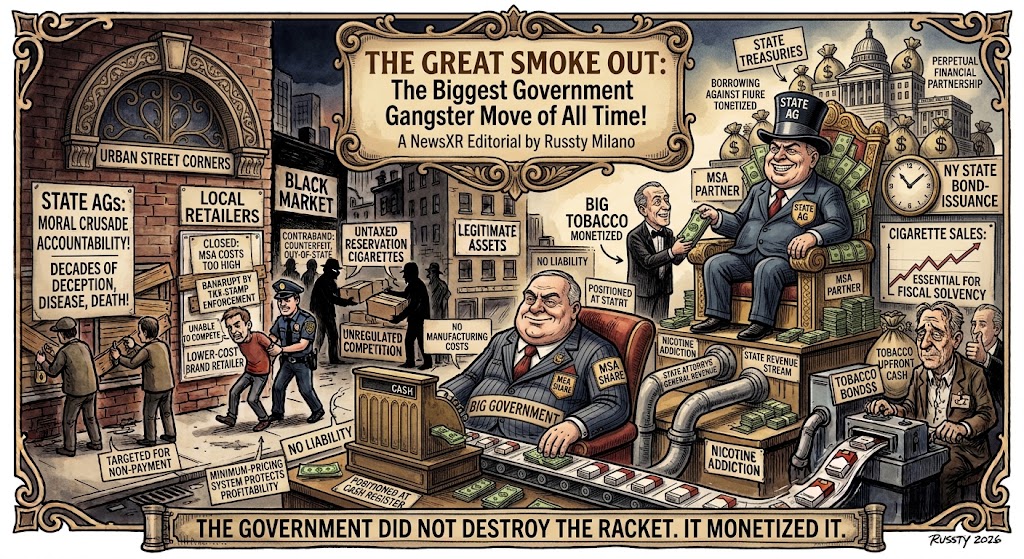
The conventional historical narrative portrays the 1998 Tobacco Master Settlement Agreement (MSA) as a triumphant moral crusade that finally brought Big Tobacco to its knees. The raw economic reality tells a very different story: one of the largest government shakedowns ever executed under the banner of a public-health victory. State attorneys general aggressively vilified the tobacco industry, declaring that they were holding corporate predators accountable for decades of deception, addiction, disease, and death. That moral outrage became the justification for forcing the major tobacco manufacturers into a multi-billion-dollar financial arrangement unlike anything seen before. Yet once the settlement was signed and the money began flowing, the supposed war of eradication became something else entirely. The government did not destroy the tobacco racket. It forced its way into the revenue stream.
In a very real economic sense, government became a partner in Big Tobacco. The states created a system in which billions of dollars would continue flowing into public coffers so long as Americans continued buying cigarettes, effectively tying government revenue to the continued existence of the very industry officials had spent years publicly condemning. Rather than simply punishing tobacco companies and walking away, the settlement established a permanent financial relationship between cigarette sales and state treasuries. The government carried none of the manufacturing costs, inventory risk, corporate liability, advertising expense, or operational burden of selling cigarettes, yet positioned itself to collect enormous sums generated by every legal pack moving through the system. Big Tobacco survived, but now it operated inside a financial structure in which government had secured its own permanent share.
The hypocrisy became even harder to ignore when states began borrowing against that future tobacco money. New York and other states issued tobacco-settlement bonds, converting decades of anticipated payments into immediate cash and effectively placing a financial value on the expectation that substantial cigarette consumption would continue far into the future. Think about the contradiction. Government publicly declared smoking a deadly scourge while simultaneously constructing long-term financial instruments whose repayment depended upon continuing tobacco revenue. The same public institutions warning citizens to stop smoking were now financially exposed to what would happen if cigarette sales collapsed too quickly. Government had managed to transform nicotine addiction from merely a public-health crisis into a revenue stream with bondholders, budgets, appropriations, and political interests attached to it.
Once billions of dollars in government revenue became intertwined with cigarette sales, the relationship between regulator and industry became fundamentally compromised. Tobacco taxation, minimum-pricing systems, settlement-payment requirements, and restrictions affecting lower-cost competitors helped create a heavily controlled cigarette market in which the established manufacturers remained dominant and government continued collecting enormous sums. What began as a punishment for Big Tobacco evolved into an economic structure that required Big Tobacco to remain sufficiently profitable to keep producing the money government had already incorporated into its fiscal machinery. The government did not need to own a tobacco factory, ship a carton, employ a salesman, or assume the liability of producing cigarettes. It simply positioned itself at the cash register.
Then greed created another entirely predictable consequence. By steadily loading legal cigarettes with taxes, mandatory minimum prices, settlement costs, and regulatory expenses, government helped push the legitimate product beyond what many ordinary working smokers could reasonably afford. That enormous price gap did not make demand magically disappear; it helped create fertile ground for a thriving black market in untaxed, out-of-state, counterfeit, and otherwise illicit cigarettes. The result is a spectacular piece of self-inflicted economic damage: government loses the very tax revenue it was trying to maximize, while legitimate convenience stores, gas stations, neighborhood markets, and other licensed retailers are forced to compete against sellers operating outside the legal tax structure. New York itself acknowledges that contraband cigarette trafficking deprives communities of revenue and places law-abiding businesses at a competitive disadvantage. The state pushed the legal price so high that it helped create an underground competitor to its own carefully constructed revenue machine, injuring legitimate retailers while driving part of the market completely beyond the government’s reach.
That is the part of the Tobacco Master Settlement Agreement that rarely fits comfortably inside the heroic version of the story. Government condemned the tobacco industry, extracted billions from it, built future budgets around those proceeds, borrowed against anticipated cigarette revenue, taxed the product relentlessly, and then maintained a regulatory environment in which the legal tobacco market continued generating the money everyone had come to depend upon. Big Tobacco was never truly destroyed. It was reorganized into a system in which government became one of the largest financial beneficiaries of its continued existence.
The great smoke out never happened. The government did not eliminate the racket.
It monetized it.