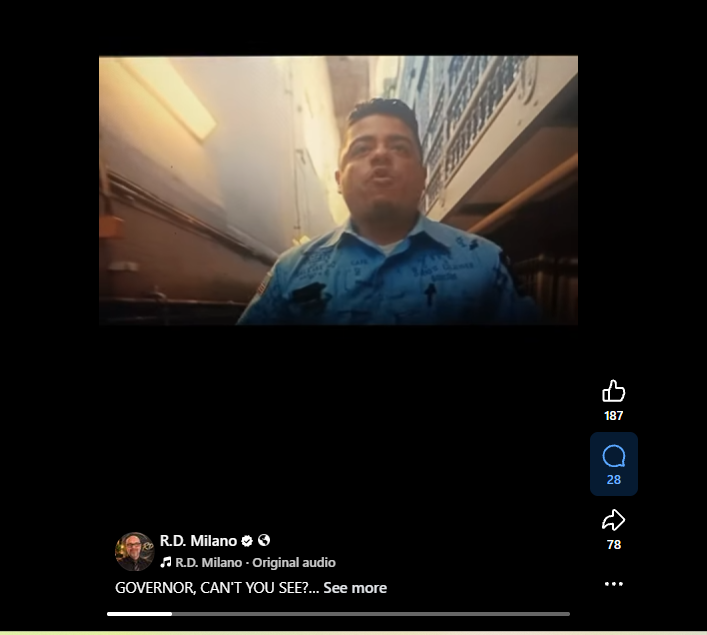
GOVERNOR, CAN’T YOU SEE?
An Urgent Open Letter to Governor Kathy Hochul
An Appeal for Meaningful NYS Prison Reform and a Personal Offer to Help
By R.D. Milano | Publisher & Editor-in-Chief, NewsXR
BINGHAMTON, NEW YORK | October 29, 2026
Dear Governor Hochul,
I am writing to you today not simply as the Publisher and Editor-in-Chief of NewsXR, an independent national news organization headquartered in Binghamton, New York, but as a formerly incarcerated New Yorker who has personally experienced the institutional culture within the New York State Department of Corrections and Community Supervision. My experiences span nine correctional facilities, where I witnessed conditions and practices that have left me deeply concerned about the future of our state’s correctional system. I have spoken publicly about these problems before, and I have previously offered to assist your administration in finding meaningful solutions. Today, I am renewing that offer with an even greater sense of urgency.
Governor, a video featuring a New York State correction officer speaking candidly about conditions within DOCCS is circulating widely on social media. In that video, the officer raises legitimate concerns about the treatment of correction officers, the failure of state leadership to provide safe working conditions, and the possibility of another tragedy resembling the 1971 Attica prison uprising. He also makes a particularly troubling observation about the power correction officers hold over the state’s prison system and, by implication, the officials responsible for governing it. I believe his remarks deserve your personal attention, not because every conclusion he reaches is correct, but because his words reveal the depth of the institutional crisis confronting New York.
I have shared that video publicly under the title “GOVERNOR, CAN’T YOU SEE?” It has attracted considerable attention from correction officers, formerly incarcerated individuals, families, and people concerned about the future of our correctional institutions. What makes this discussion important is that the officer’s account represents only one side of a much larger story. There is another perspective that has too often been absent from the public conversation, and I know that perspective because I lived it.
I have therefore published a personal account titled “SETTING THE RECORD STRAIGHT: The Other Side Left Out a Few Things.” In that testimony, I describe the institutional culture I encountered, including the harassment, intimidation, unnecessary confrontations, and failures of accountability that I witnessed throughout my incarceration. I also explain how the conduct of certain correction officers can contribute to the very hostility and violence that prison officials subsequently cite as justification for increasingly restrictive conditions. These are not conclusions drawn solely from reports, political arguments, or secondhand accounts. They are observations and experiences from years spent living within the system your administration is responsible for overseeing.
Governor, I want to be absolutely clear about something. I do not regard correction officers as my enemies. Throughout my incarceration, I encountered men and women who genuinely wanted to perform their duties honorably, and I also witnessed how an institutional culture of hostility, silence, and misplaced loyalty could undermine even those with good intentions. I believe many correction officers have themselves been harmed by the environment in which they work, just as incarcerated people have suffered under its failures. This is not simply a dispute between officers and prisoners. It is an institutional problem that has damaged both, and it demands solutions that recognize the humanity and legitimate interests of everyone involved.
While incarcerated, I often prayed that the men and women who held authority over us would experience an awakening of conscience. I hoped they would recognize the humanity of those entrusted to their custody and rediscover the compassion and moral judgment that the institutional culture had taught so many to suppress. I still offer those prayers today, not from behind prison walls, but as a free man who continues to hope for an awakening of conscience among his former captors. I do not seek revenge against those who once held authority over me. I seek meaningful change so that others will not have to endure what I witnessed and experienced.
The correction officer in the video warns about another Attica. Governor, I ask you to consider what made Attica possible in the first place. The 1971 uprising did not emerge in a vacuum, and the suffering and deaths that followed remain among the darkest chapters in New York’s correctional history. Conditions of despair, institutional hostility, failed communication, and the absence of meaningful accountability can create an environment in which tragedy becomes increasingly possible. When someone working inside today’s correctional system raises the specter of another Attica, that warning deserves serious consideration. But any honest examination must also confront the role that institutional conduct and administrative failures can play in creating the conditions that lead to such disasters.
New York has already witnessed the extraordinary power correction officers can exercise over the operation of its prisons. The 2025 wildcat strike demonstrated how quickly the system can be destabilized when the workforce and state leadership reach an impasse. At the same time, the state’s continuing struggles with violence, abuse allegations, staffing, and implementation of correctional reform reveal problems that cannot be solved through temporary concessions or changes in policy alone. The culture itself must change, and that transformation requires leadership willing to confront uncomfortable truths, including those raised by people who have experienced incarceration firsthand.
Governor Hochul, I believe this moment presents an opportunity for leadership far greater than simply responding to another controversy. New York has the resources, knowledge, and institutional capacity to develop a correctional system that could become a national model for public safety, professional correctional employment, accountability, rehabilitation, and respect for human dignity. Achieving that goal will require more than another investigation or another round of administrative adjustments. It will require a fundamental reconsideration of what our correctional institutions are expected to accomplish, how authority is exercised within them, and how both employees and incarcerated individuals are protected from abuse.
That brings me to the purpose of this letter beyond asking you to watch the video and read my testimony.
Governor, I do not wish to be merely another critic standing on the sidelines pointing out what is wrong. I want to be part of the solution.
I have made this offer before, and I am making it again today. I am willing to contribute my firsthand knowledge, my experiences across nine state correctional facilities, and my understanding of the institutional culture to any serious effort your administration undertakes toward meaningful correctional reform. I am prepared to sit at the table with correctional administrators, conscientious correction officers, formerly incarcerated individuals, advocates, and state officials to help identify the practices that perpetuate hostility and abuse and develop practical alternatives. I believe those who have lived within the system possess knowledge that cannot be fully captured through official reports, administrative briefings, or scheduled inspections.
My willingness to help is genuine. I am not seeking an opportunity merely to criticize your administration or to revisit the suffering of my past. I am offering to use those experiences constructively, in the hope that something meaningful can emerge from them. I have rebuilt my life, established a national news organization, and worked to contribute positively to the community and society to which I returned. I believe that experience also demonstrates something essential about the purpose of corrections: people can change, lives can be rebuilt, and institutions should be structured to make those outcomes more likely rather than more difficult.
I recognize that the responsibility resting on your shoulders is substantial. Governing a state as large and complex as New York requires difficult decisions, and meaningful institutional reform will encounter resistance from people who have become accustomed to the existing system. Nevertheless, the measure of leadership is not simply the ability to manage the institutions we inherit. It is the willingness to change them when experience and evidence demonstrate that they are failing the people they are intended to serve.
Governor Hochul, I am asking you personally to watch “GOVERNOR, CAN’T YOU SEE?” and read “SETTING THE RECORD STRAIGHT.” Hear the correction officer’s concerns, but hear mine as well. Consider the experiences of the families, employees, and formerly incarcerated people who are participating in this conversation. Their perspectives may differ, sometimes profoundly, but all deserve to be heard in an honest effort to understand what has gone wrong.
And once again, I respectfully extend my offer to help your administration become part of the solution. I am willing to meet, to listen, to share what I know, and to work toward reforms that protect correction officers, safeguard incarcerated individuals, strengthen accountability, and restore public confidence in New York’s correctional institutions.
New York does not have to accept the continuation of the institutional failures that have defined too much of its correctional history. We can build something better, and I believe the people of this state deserve nothing less.
Governor, the warning signs are before us. The opportunity to act is before you.
Governor Hochul, can’t you see?
Respectfully,
R.D. Milano
Publisher & Editor-in-Chief
NewsXR | Interactive News Network
Binghamton, New York
RELATED VIDEO AND TESTIMONY
Here’s the Facebook Reel link:
GOVERNOR, CAN’T YOU SEE?
https://www.facebook.com/reel/1637757197808732
SETTING THE RECORD STRAIGHT: The Other Side Left Out a Few Things
A firsthand account by R.D. Milano examining the institutional culture within NYS DOCCS.
[CLICK HERE]
© 2026 NewsXR. All Rights Reserved.